Monday, July 31, 2023

Xen Orchestra 5.85

Xen Orchestra 5.85

Even as we bask in the peak of the Northern hemisphere's summer, our commitment hasn't taken a vacation. We're thrilled to roll out intricate updates, notably to our V2V (VMware to Vates) tool and the much-anticipated Netbox synchronization plugin 2.0. And the excitement doesn't stop there: explore the new additions to XO Lite and a host of other enhancements. Dive in and make the most of them!

You can also listen it as a Podcast :

🐦 VMware migration tool (V2V)

We're thrilled to announce that our VMware to Vates (V2V) tool now fully supports warm migrations to XCP-ng across all VMware versions, including the most recent ones.

For those new to this, our V2V tool simplifies the migration process by letting you effortlessly connect a vSphere setup from Xen Orchestra. All you need to do is select the VMs you wish to migrate and hit "Migrate." The magic of warm migration? Your VM will be snapshotted and sent to XCP-ng while it's still running. After the completion, we'll shut it down, send any differential data, and then boot it up on the XCP-ng end. This means minimal disruptions and downtime for you.

For those who love the nitty-gritty, we've also updated our guide, ensuring you have a comprehensive understanding of every step:

Migrate from VMware to XCP-ng
Vmware v6 is now end of life, the right time to migrate to an open source, less expensive and constantly evolving solution: XCP-ng.
Xen Orchestra 5.85XCP-ng BlogOlivier Lambert
Xen Orchestra 5.85

If you're looking for some real-world inspiration, check out this recent success story on a migration from VMware to Vates:

Leading the Pack: MANI Indústrias Plásticas SA’ Journey with Vates Virtualization Management Stack
Situated at the forefront of the industry, MANI SA exemplifies a commitment to innovation and forward-thinking. This implementation serves as a stellar instance of Industry 4.0 in action, seamlessly integrating cutting-edge technology with traditional manufacturing operations.
Xen Orchestra 5.85XCP-ng BlogMarc Pezin
Xen Orchestra 5.85
☝️
A little behind-the-scenes tidbit: To ensure compatibility with VMware versions after 6.5, we had to navigate the proprietary SESparse format, which unfortunately lacks official documentation. But, kudos to the Qemu project! Their prior efforts in reverse engineering the format became our guiding light, enabling us to reimplement it in Javascript.

🗃️ Netbox

Remember the Netbox plugin we introduced two years ago? We've taken a trip down memory lane, reflecting on its capabilities and limitations. We realized it was high time to supercharge it. After an immense amount of work, we're delighted to unveil the revamped Netbox plugin!

DevBlog #9 - Netbox synchronization with XO
When you start to have a lot of virtual machines and IP addresses, you might need to organize a bit with an IPAM. Netbox is such a thing.
Xen Orchestra 5.85Xen Orchestra BlogOlivier Lambert
Xen Orchestra 5.85

We considerably improved the synchronization, to manage many use cases that weren't covered by our previous code.

Prerequisite

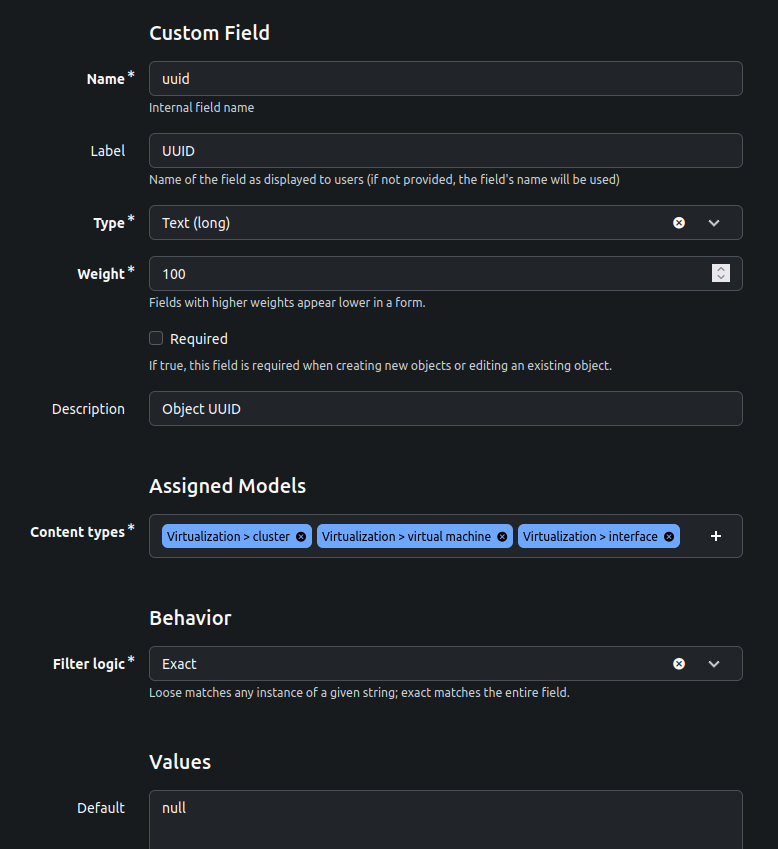
You must add an UUID custom field for 3 objects in Netbox: "Virtualization > cluster", "Virtualization > virtual machine" and "Virtualization > interface".

See this screenshot:

Xen Orchestra 5.85

Improvements & fixes

Here's a rundown of the most significant changes:

  1. Comments Integration: VM descriptions now sync seamlessly into the 'Comments' field of the VM Netbox object. It's a small touch, but it makes a world of difference by adding context when you're browsing through your Netbox tab.
  2. Operating system information: the distro name and number is also sent to Netbox!
  3. Migrating VMs: We've enhanced the migration process. Now, rather than deleting and recreating a VM during migration, we update the existing VM object. This ensures that any manually added data remains intact.
  4. No More VM Duplication: In the past, actions like replacing a pool in your setup (for instance, migrating all VMs, connecting/syncing the new pool, and disconnecting the old one) would result in VM duplication in Netbox. We've ironed out this issue to ensure a smoother experience.
  5. IP Prefix Handling: We've corrected an inconsistency where IPs would sometimes bind to the largest IP prefix rather than the smallest.
  6. Synchronization Enhancements: Disconnecting a pool from Xen Orchestra won't derail the synchronization process anymore. If a pool is unreachable, our plugin simply sidesteps it, ensuring the rest of the sync proceeds smoothly.
  7. Clearer Error Messages: Troubleshooting has never been easier. We've fine-tuned error messages to display a sample of objects causing sync issues. This makes it easier to identify and rectify problems.
💡
This huge revamp of the Netbox sync plugin is also opening the door to more features and improvements in the future: synchronize VM tags, sync to multiple Netbox instances, with the VM DNS name, IP range exclusion, but also host synchronization, clickable link in XO directly, tag exclusion… You name it!

🔭 XO Lite

There are new available features in this XO Lite release!

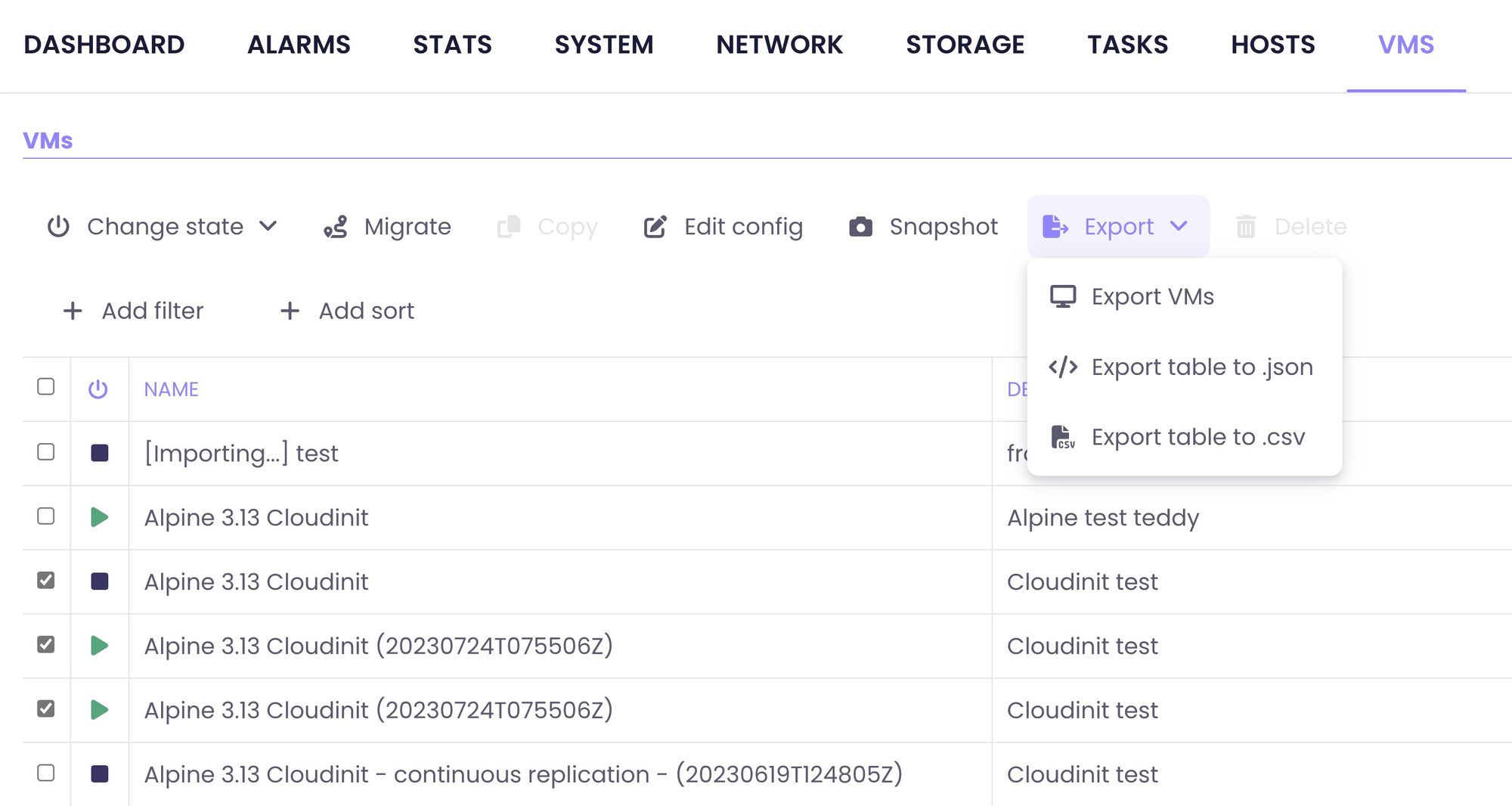
Export VMs in CSV or JSON

On the Dashboard view, in the VM list, you can now export all selected VMs information into a CSV or JSON file:

Xen Orchestra 5.85

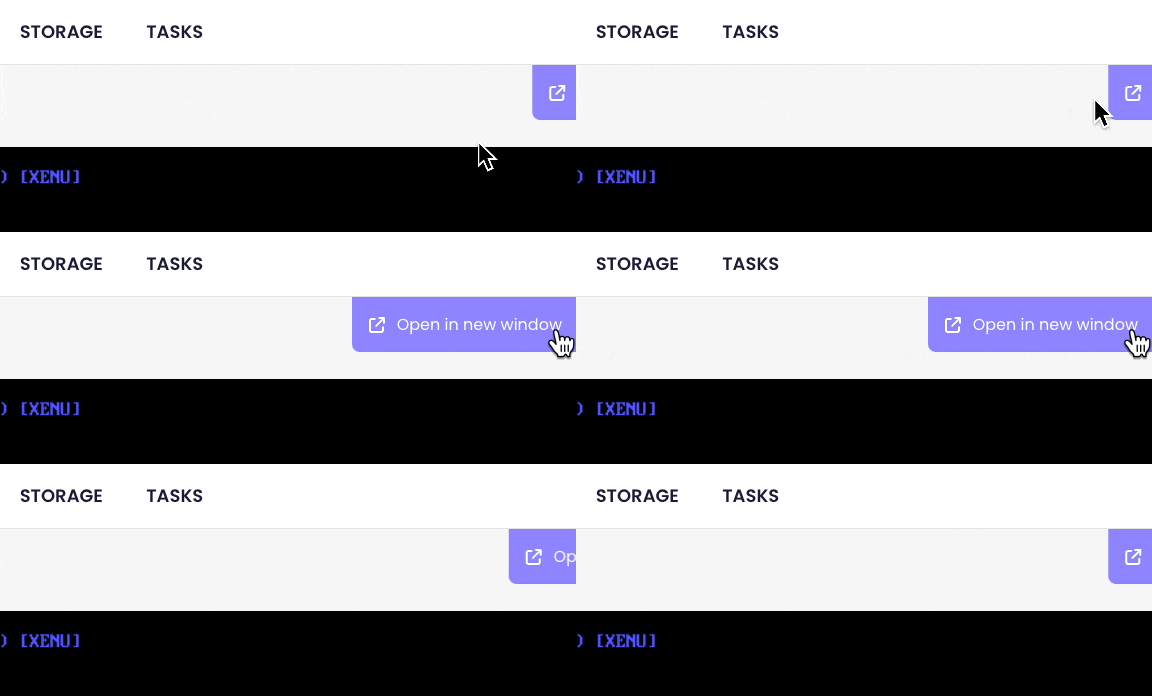
Pop up console

You can simply display a VM console in a new pop-up window! It's convenient, especially if you want to display multiple consoles at once.

The icon is easily found on the VM console page:

Xen Orchestra 5.85

Also, the VM console view is even better:

0:00
/

Tasks on the dashboard

All XCP-ng tasks are now visible in the dashboard:

Xen Orchestra 5.85

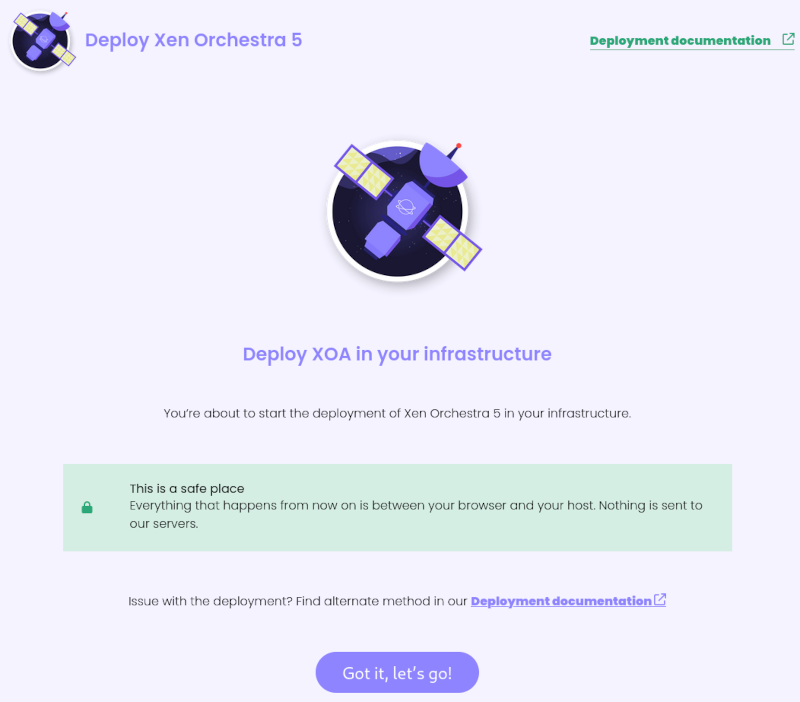
🛰️ New XOA Deploy

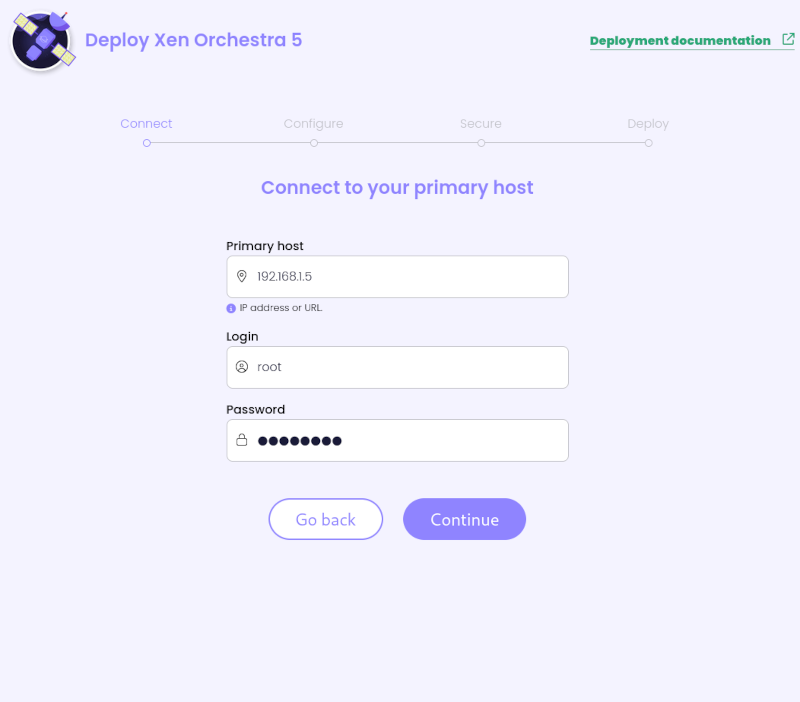
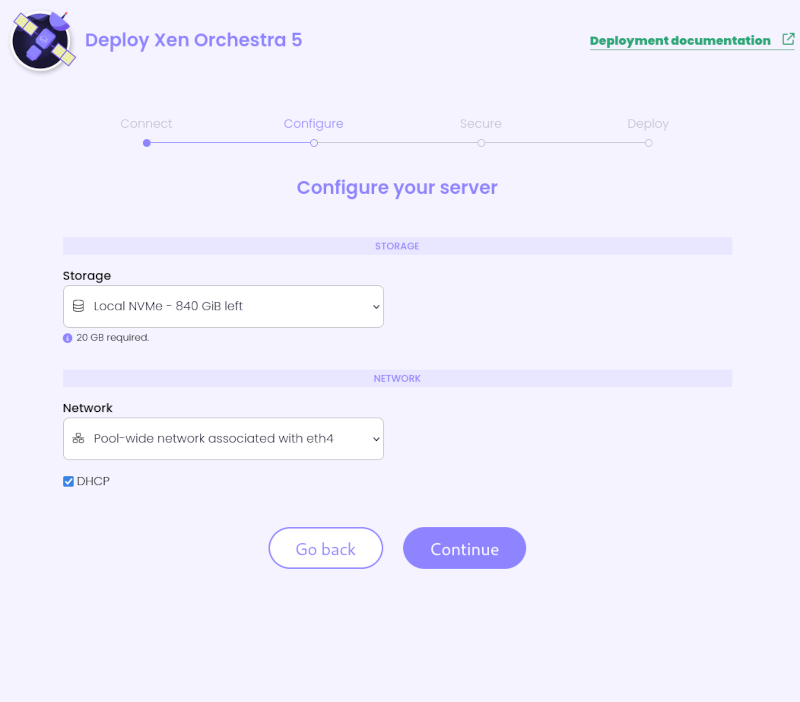
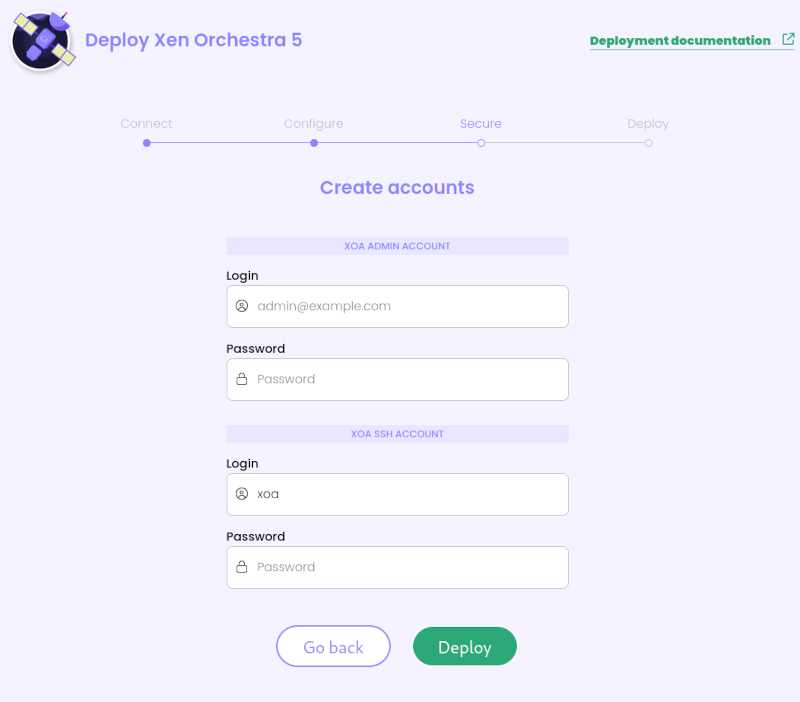
We improved the way to deploy XOA via our website. It's now available at https://vates.tech/deploy/

Xen Orchestra 5.85
Xen Orchestra 5.85
Xen Orchestra 5.85
Xen Orchestra 5.85

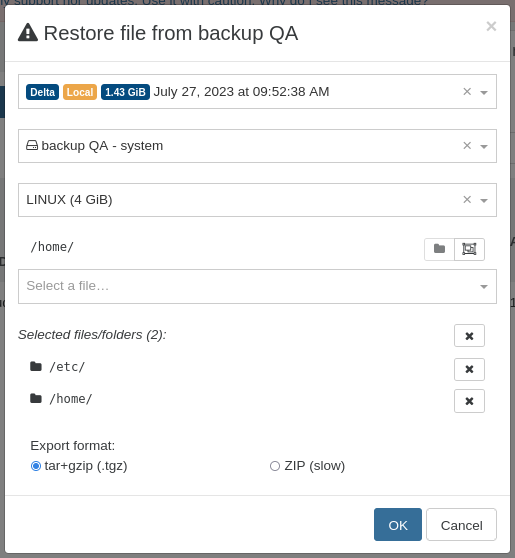
📂 Faster file level restore

Until now, we used the ZIP format to pack and compress all the files you wanted to restore in a VM backup. This format is very common, but suffer from being bad at streaming data.

We detected the issue with users having thousand of files to ZIP, it took ages or consume all XOA's memory. So instead of ZIP, we aded tar+gzip (archive + compression), which is a LOT better to do this. Our first results are displaying that tar+gzip is at least 6 times faster than ZIP alone. Nice isn't it?

Xen Orchestra 5.85


from Xen Orchestra https://bit.ly/44MUiXz
via IFTTT

The Nightmare Of Destructive Malware | From Wiper To SwiftSlicer

In partnership with vx-underground, SentinelOne recently ran its first Malware Research Challenge, in which we asked researchers across the cybersecurity community to submit their research to showcase their talents and bring their insights to a wider audience.

In today’s guest post, researcher Natacha Bakir (Senthorus/Cefcys) digs into the destructive world of wipers: a special class of malware that has neither espionage nor financial gain in mind, but exists solely to destroy data and disrupt the services provided by an organization to its consumers. From MeteorExpress to AcidRain and HermeticWiper, the current increase in the use of wipers since the start of Russia’s invasion of Ukraine has been unprecedented and is a subject worthy of greater attention.

In February 2022, Ukraine was targeted by a new malware named ‘HermeticWiper’. Amid reports of ransomware incidents increasing by 62% in 2021, and the number of ransomware attacks estimated at 236.1 million in the first half of 2022, this new malware, as sophisticated as it was, had a simple goal: to erase the target’s disks.

While wipers have been known for over 10 years, a significant rise in this destructive kind of malware has been noted since 2022. In this post, I will briefly discuss the history of wiper malware before focusing on the the techniques used in some of the most recent attacks.

History of Wipers

2012 was an important year for wipers. On August 15th, Shamoon wiped 30000 systems within a day. The New York Times estimated that 75% of the victim’s computers had been wiped. At the time, it was one of  the most destructive attacks ever seen. A group calling itself “Cutting Sword of Justice” claimed responsibility for the attack, blaming the al-Saud regime for crimes against humanity.

In 2015, an attack on the Ukraine Power grid caused a power outage for nearly a quarter of a million people. It was coordinated with a Denial-of-service attack on a call center to deny consumers up-to-date information on the blackout.

In 2022, WhisperGate wiper targeted multiple organizations in Ukraine. The wiper was later seen throughout the world.

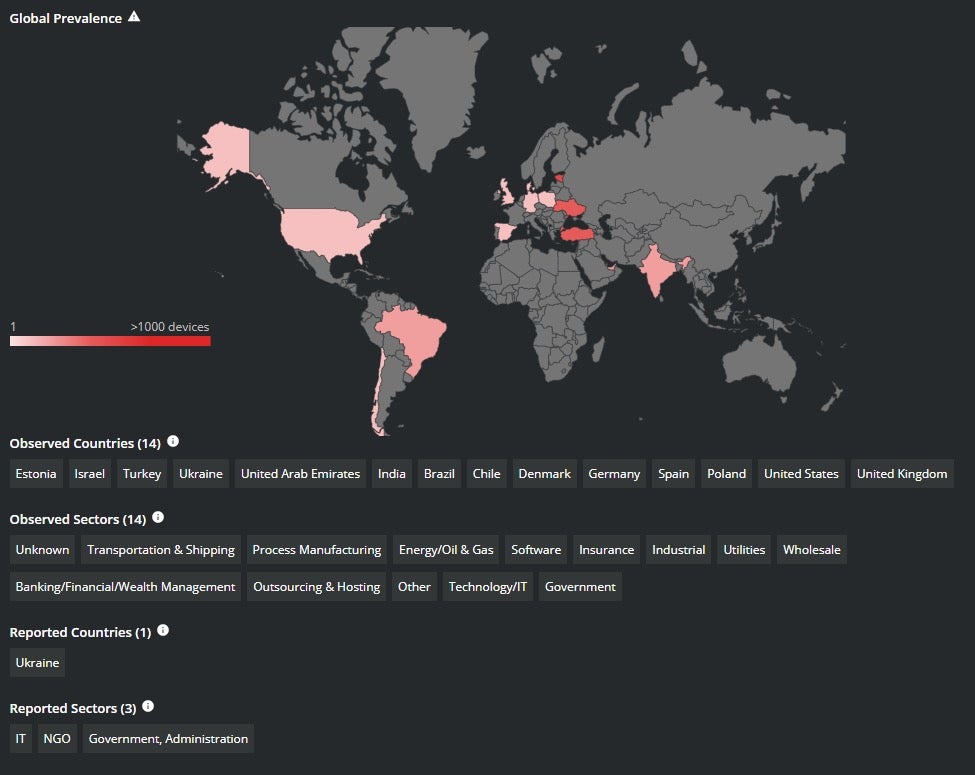
Source: Trellix

The WhisperGate wiper had a decoy ransom note to mislead Incident Response teams. The wiper analyzes the victim’s environment enumerating OS attributes and disks to improve their access and gain the desired privileges to disarm the victim and attack.

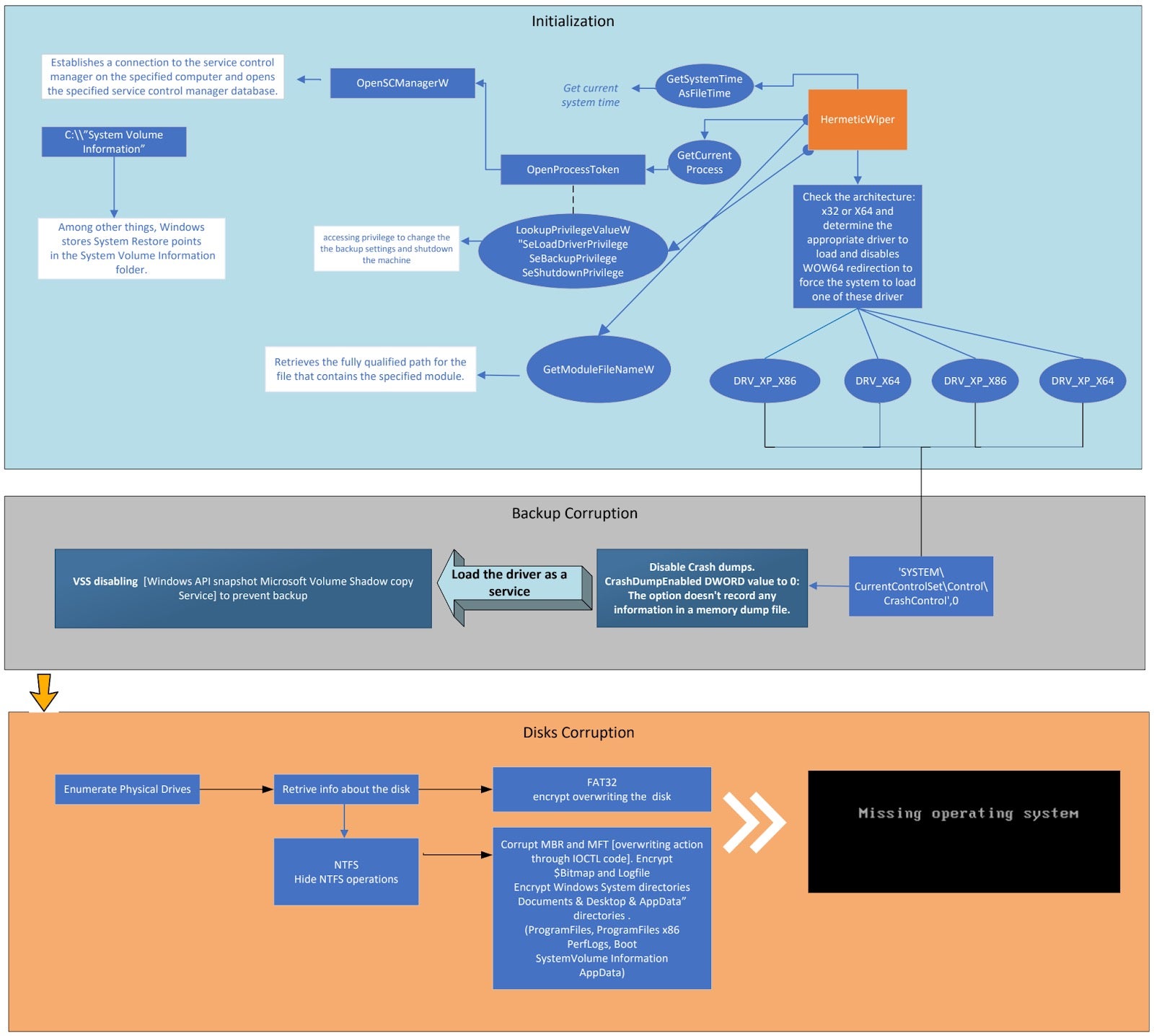
In February 2022, HermeticWiper was dropped on victims via a compressed package, creating the EaseUS driver file, and enumerating the physical drives. The driver then loads and runs as a service. The driver is used through execution codes [dwIoControlCode] to overwrite the master boot record (MBR) and the master file table (MFT) before restarting the system.

In January 2023, ESET researchers uncovered a new wiper attack targeting Ukraine called SwiftSlicer. The wiper uses Active Directory Group Policy and is written in Go. ESET attributed this attack to Sandworm.

Wiper Techniques

Wipers primary goal is to destroy data. This can cause disruption and service outage affecting not just the organization targeted but entire populations. Wipers can also be deployed after an initial attack, in order to erase evidence. Although wipers can be disguised as ransomware and ask for a ransom, they don’t offer the capability to recover data and the goal is not financial gain, but rather a diversionary tactic while data is erased.

Depending on the hacker’s goal (discretion, speediness), several techniques of wiping are used, including:

  • enumerating the filesystem
  • overwriting the disks with other data like zero (0x00) bytes
  • corrupting MBR and MFT
  • fragmenting disks
  • using driver to gain kernel access
  • pass order through IOCTL DeviceIoControl() function.
HermeticWiper Architecture
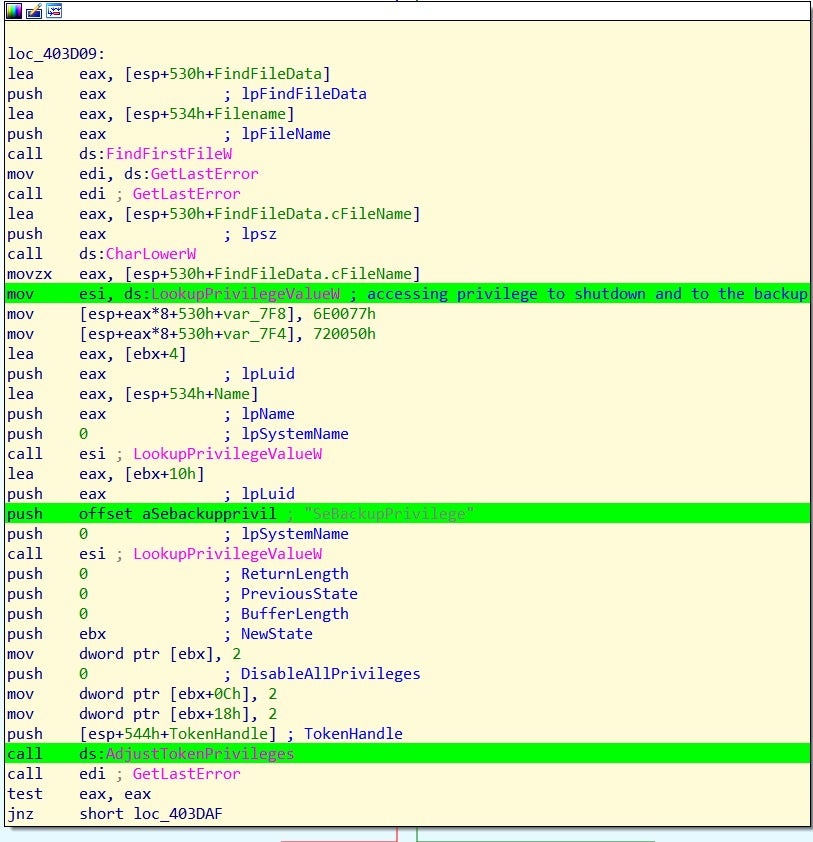
Hermetic Wiper disassembly
 SwiftSlicer
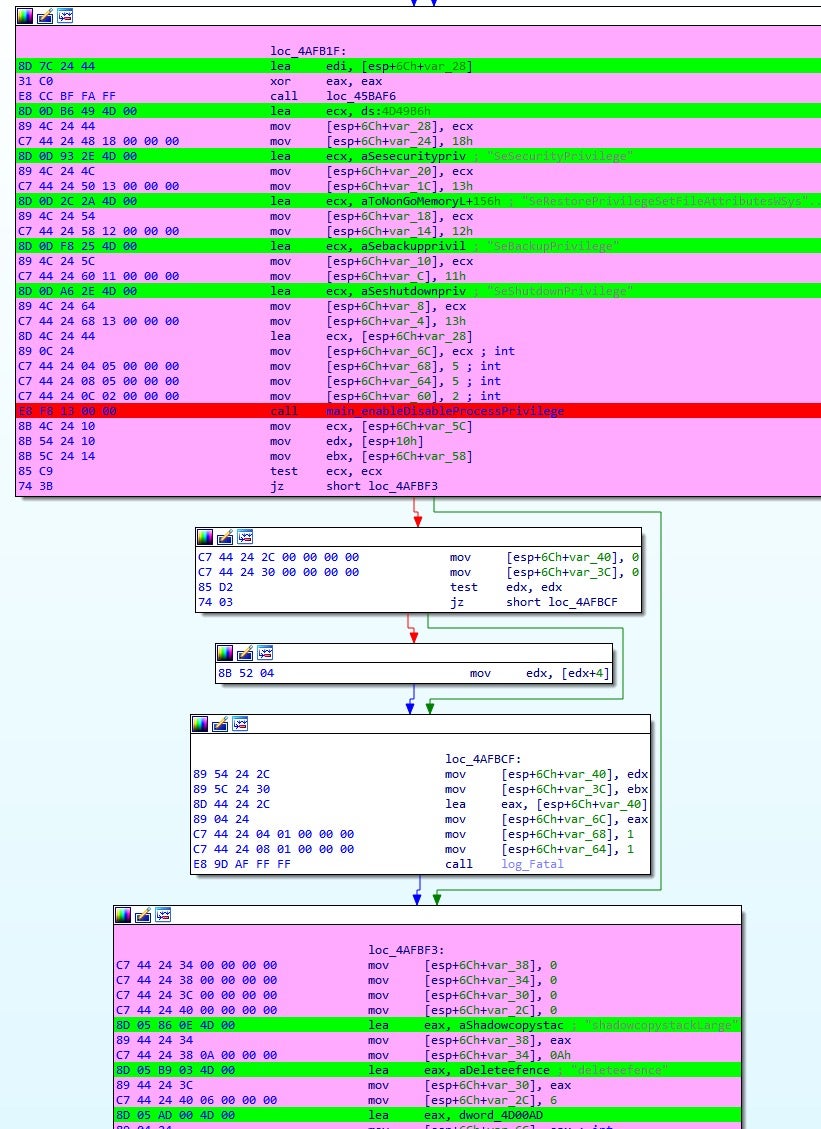
[caption] SwiftSlicer disassembly

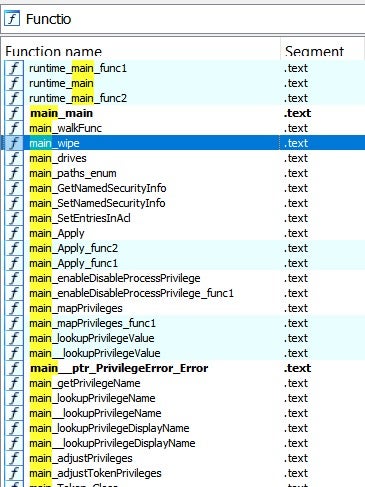
Given the simplicity of the goal, Wipers can be written in many different programming languages. Although SwiftSlicer is written in Go, similarities in the malware’s functionality can clearly be seen.

The Ukrainian CERT-UA reports that SwiftSlicer was distributed to network computers through GPO (Group Policy Object), the same method used to deploy most of the malware mentioned in this article.

They also noted that the malware targets the %CSIDL_SYSTEM_DRIVE%\Windows\NTDS folder, showing that SwiftSlicer tries to destroy files and bring down the entire Windows domain.

SwiftSlicer targets Windows system drivers

Why Write a Wiper in Go?

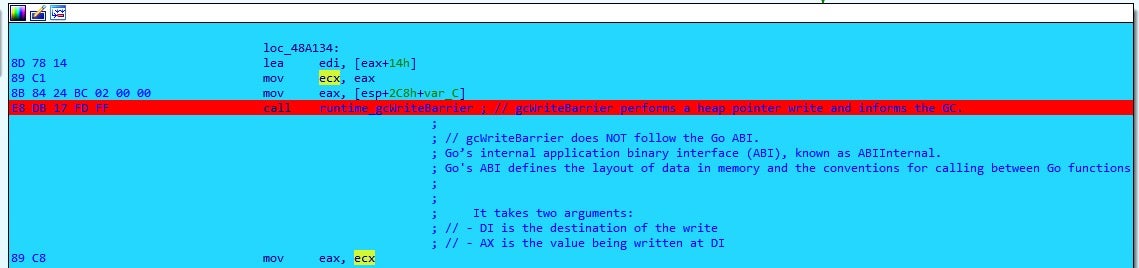
Go is increasingly used in malware programming. With Go, malware developers can write code once and compile binaries from the same codebase for multiple platforms. As a result, they can target different operating systems like Unix, Linux, Windows and those that work on mobile.

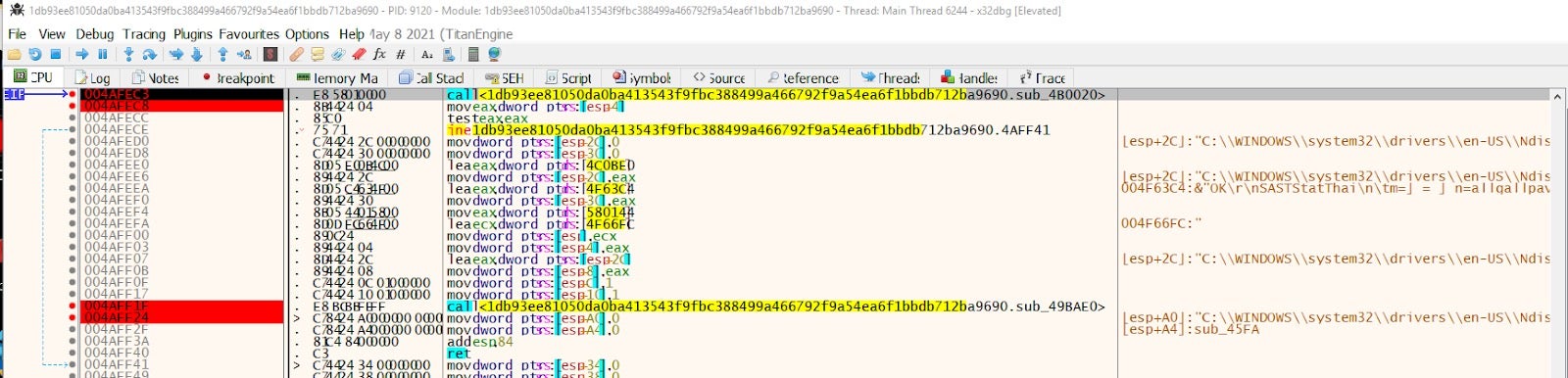
In addition, Go programs can be difficult to analyze. The arguments are not passed through registers but are directly copied onto the stack at the correct position. Further, Go functions can have multiple return values, so static analysis is limited. Typically, when reversing go malware, analysts will need to use dynamic analysis, such as isolating interesting functions by name and using a debugger to break on interesting calls to inspect the program’s state.


Conclusion

Wiper malwares are not new, and even Russia’s use of them against Ukraine can be dated back to interference in the Ukraine Presidential Election of 2014. However, the extent of the use of wipers by Russian APT groups, especially Sandworm, against Ukrainian targets is something not seen previous to this conflict.

Whether used for sabotage or cyberwarfare, wipers cross the boundary of the virtual to the real, with the potential to wreak devastating effects on those far beyond the organization targeted.


from SentinelOne https://bit.ly/44MPcdT
via IFTTT

Patchwork Hackers Target Chinese Research Organizations Using EyeShell Backdoor

Jul 31, 2023THNCyber Espionage / Malware

Threat actors associated with the hacking crew known as Patchwork have been spotted targeting universities and research organizations in China as part of a recently observed campaign.

The activity, according to KnownSec 404 Team, entailed the use of a backdoor codenamed EyeShell.

Patchwork, also known by the names Operation Hangover and Zinc Emerson, is suspected to be a threat group that operates on behalf of India. Active since at least December 2015, attack chains mounted by the group have a narrow focus and tend to single out Pakistan and China with custom implants such as BADNEWS via spear-phishing and watering hole attacks.

The adversarial collective has been found to share tactical overlaps with other cyber-espionage groups with an Indian connection, including SideWinder and the DoNot Team.

Earlier this May, Meta disclosed that it took down 50 accounts on Facebook and Instagram operated by Patchwork, which took advantage of rogue messaging apps uploaded to the Google Play Store to collect data from victims in Pakistan, India, Bangladesh, Sri Lanka, Tibet, and China.

"Patchwork relied on a range of elaborate fictitious personas to socially engineer people into clicking on malicious links and downloading malicious apps," the social media giant said.

"These apps contained relatively basic malicious functionality with the access to user data solely reliant on legitimate app permissions granted by the end user. Notably, Patchwork created a fake review website for chat apps where they listed the top five communication apps, putting their own, attacker-controlled app at the top of the list."

Some of its activities have also been reported under the name ModifiedElephant, according to Secureworks, referring to a set of attacks against human rights activists, academics, and lawyers across India to conduct long-term surveillance and plant "incriminating digital evidence" in connection with the 2018 Bhima Koregaon violence in the Indian state of Maharashtra.

EyeShell, detected alongside BADNEWS, is a a .NET-based modular backdoor that comes with capabilities to establish contact with a remote command-and-control (C2) server and execute commands to enumerate files and directories, downloading and uploading files to and from the host, execute a specified file, delete files, and capture screenshots.

The findings come as the cybersecurity company also detailed another wave of phishing attacks orchestrated by a group called Bitter aimed at aerospace, military, large enterprises, national government affairs, and universities in the country with a new backdoor known as ORPCBackdoor.

The South Asian threat actor was previously detected targeting the nuclear energy industry in China with malware downloaders delivered via CHM and Microsoft Excel Files that are designed to create persistence and retrieve further payloads.

Found this article interesting? Follow us on Twitter and LinkedIn to read more exclusive content we post.


from The Hacker News https://bit.ly/44O8EXx
via IFTTT

Webinar: Riding the vCISO Wave: How to Provide vCISO Services

Jul 31, 2023The Hacker NewsVirtual CISO

Demand for Virtual CISO services is soaring. According to Gartner, the use of vCISO services among small and mid-size businesses and non-regulated enterprises was expected to grow by a whopping 1900% in just one year, from only 1% in 2021 to 20% in 2022!

Offering vCISO services can be especially attractive for MSPs and MSSPs. By addressing their customers' needs for proactive cyber resilience, they can generate a growing amount of recurring revenue from existing and new customers. And all while differentiating themselves from the competition. vCISO services also enable upselling of additional products and services the MSP or MSSP specializes in.

However, not all MSPs and MSSPs fully understand how to provide vCISO services. Some may be unsure about which services are expected from them. Others may not realize they are already providing vCISO services and have the potential to effortlessly broaden their offerings into a complete vCISO suite or package it differently to make it more lucrative.

Cynomi has leveraged its strong presence in the vCISO ecosystem and invited Dr. Jerry Craig, CISO at Ntiva, to a discussion with David Primor, CEO of Cynomi, about the vCISO practice and the opportunity it holds.

This discussion is aimed at MSPs and MSSPs who are looking for ways to benefit their customers while boosting their cybersecurity service offerings and revenue.

This webinar from Cynomi shares tips and insights on the following topics:

  • The R&Rs of vCISOs
  • The advantages of offering vCISO services for MSPs and MSSPs
  • How to identify if you are already delivering some vCISO components
  • What to look out for when creating your vCISO offer
  • How to start providing vCISO services

Among the insights from this discussion:

  • Many MSPs and MSSPs are already providing some vCISO services without knowing. For example, if you are managing your customer's security, managing risk, supporting compliance needs, creating a security strategy, or offering training, you are on your way to becoming a vCISO. With the right tools, you can easily expand your offering and repackage it as a vCISO service, instead of only offering specific products.
  • Offering vCISO services is a key factor in MSP and MSSP growth, since it helps gain a competitive advantage and enhance revenue streams through services that are in high demand.
  • There is no one-size-fits-all in security. It's up to you to learn your customers' needs and build a tailored security program for them.
  • As a vCISO, you can leverage your broad industry view to identify common gaps and trends, build a tailored solution and offer it to your customers.
  • Using a vCISO platform is a significant component of the vCISO strategy. It enables filling in the gaps in your vCISO offering, scaling your offering and efficiently communicating with management, while overcoming the skills shortage gap.

Watch the full discussion to learn from experienced professionals who've already been around the block and are ready to share their experiences. Learn how to tailor a vCISO offering, which pitfalls to avoid, and which tools and frameworks will help you succeed in this rapidly growing field.

Watch the webinar here.

Found this article interesting? Follow us on Twitter and LinkedIn to read more exclusive content we post.


from The Hacker News https://bit.ly/3Oz0VXM
via IFTTT

Is CompTIA Security+ Worth It? A Must-Read Review (2023)

Taking the CompTIA Security+ exam is a big step toward realizing your career dreams in cyber security. You’ll want to know how long you’ll study, your budget, and your preparation schedule. If you’re thinking, “Is CompTIA Security+ worth it?” we’ve got you covered.

We’ll explain how Security+ fits your IT and cyber security career journey. This article will show you how much time and money you can expect to spend if you decide to go for the Security+ exam and the doors Security+ opens for you so that you can make an informed decision on whether to pursue this certification.

If you’re ready, read on.

Top 5 Reasons to Get Your CompTIA Security+

CompTIA Security+ Certification

CompTIA Security+ Certification

The CompTIA Security+ certification shows employers that you’ve mastered the core skills to perform essential cyber security functions and pursue a relevant career. It focuses on the day-to-day real-time application of IT security knowledge at work.

You’ll need to answer at most 90 questions in this 90-minute examination and complete a survey after it ends. The passing score is 750 on a scale of 100–900.

As of the time of writing, the latest CompTIA Security+ exam code is SY0-601. The associated exam is available until July 2024. The Security+ exam domains are:

  • Attacks, Threats, and Vulnerabilities
  • Architecture and Design
  • Implementation
  • Operations and Incident Response
  • Governance, Risk, and Compliance
Security + Domains
CompTIA Security+ Domains (SY0-601)

The CompTIA Security+ certification is ideal for IT professionals with two years of IT administration experience with a cyber security focus or equivalent training who are starting or furthering a career in cyber security. Anyone who wants to break into cyber security and have the necessary foundational networking know-how should consider taking Security+. We go in depth in our “What Is CompTIA Security+?” article.

As a highly recognized and respected certification, Security+ is compliant with ISO 17024 standards and approved by the U.S. DoD to meet directive 8140/8570.01-M requirements. You can consider taking Security+ even if you already have years of experience in networking or cyber security. For details, refer to our articles comparing Security+ with other certifications:

Time and Financial Investment

It’s important to set aside time and money for Security+ study materials. Moreover, due to cyber security’s evolving nature, CompTIA Security+ is not a one-and-done type of certification. It expires three years after you’ve passed your Security+ exam (as most CompTIA CE certification do), and you must take up continuing education units (CEUs) to retain your credentials.

An excellent self-paced study course will prepare you well for the Security+ exam and compensate for your lack of work or hands-on experience. If you’re looking for good Security+ study resources, we’ve listed a few in the conclusion of this article.

Some students pay for additional practice tests to ensure they have all their bases covered. Being part of a Security+ study group online or offline is also helpful.

As of writing, the listed price of the Security+ exam set is $392 (USD). You have two methods to renew your certification:

  • With multiple activities: Collect at least 50 Continuing Education Units (CEUs) through CompTIA-approved activities, including advanced certifications, work experience, publishing, and participating in industry events. To renew Security+, you should upload sufficient proof of participation to your certification account and pay a renewal fee.
  • With a single activity: Advanced CompTIA certifications such as CySA+PenTest+, and CASP+ suffice to renew Security+. You can also complete CompTIA’s online, self-paced continuing education course CertMaster CE, the Security+ version of which costs $199 (USD) as of writing.

Although Security+ has no hard-and-fast prerequisites, CompTIA recommends that Security+ candidates have CompTIA Network+ and two years of experience in IT administration with a security focus. Such prior expertise helps reduce study time.

StationX Roadmaps
Location of Security+ in the StationX Cyber Security Certification Roadmap

The average time for most candidates with some technical background to prepare for the Security+ exam is 30 to 45 days. Without prior IT experience, you may need 60 days or longer. Don’t forget to check out our tips to pass Security+ when you do it the first time.

Knowledge Gained

By studying for Security+, you fill in the gaps in the latest industry knowledge that competent cyber security professionals need to know, especially if you already have information security expertise, and prove your ability in troubleshooting cyber security incidents. Such skills are valuable in penetration testing, offensive/defensive cyber security, and risk management.

From Security+ study materials, you’ll gain technical knowledge of networking and security topics, such as public key infrastructure, wireless security settings, and organizational security. If you’re new to cyber security, you can get hands-on experience by doing labs where you learn how to apply cyber security concepts to real-life scenarios.

As a cyber security professional, a solid working knowledge of various domains in cyber security can help you identify and solve cyber security problems confidently. Being in control engenders trust in your non-technical employers and clients.

Careers

CompTIA boasts that Security+ opens the door to a career in cyber security. Available since 2002, this highly respected certification exam has been around for over 20 years. CompTIA keeps Security+ up-to-date with current technologies, making it an excellent certification for anyone desiring to break into cyber security.

As a vendor-neutral certification, Security+ prepares you for many cyber security jobs. Suppose employment in cyber security is your immediate concern. In that case, your job prospects and opportunities with Security+ include the following six entry- to mid-level job types, with potential for advancement upwards toward management, or laterally, as in changing jobs:

  • Business analyst
  • Cyber security manager
  • Software developer
  • Systems administrator
  • MSP personnel
  • Security consultant

Full-timers in these six roles can earn a salary of $43k – $180k annually. Additionally, CompTIA allows you to view more descriptions of Security+ jobs by selecting from the dropdown menu on this web page.

You can find thousands of open positions that require or mention CompTIA Security+ online. As of writing, Glassdoor alone returns over 4,000 results for a US-based job search on CompTIA Security+.

Glassdoor

Meanwhile, Indeed has more than 6,000 results for US-based jobs whose descriptions mention CompTIA Security+:

Indeed

If you plan to further your cyber security career beyond that which Security+ offers and have enough work experience, consider taking up CySA+PenTest+, CASP+, CEH, or CISSP next.

For a detailed breakdown, refer to our Security+ Jobs article.

Conclusion

Security+ is an ideal certification if your goal is to break into cyber security.

The knowledge and skills in Security+ apply across most elements of the cyber security industry, including offensive/defensive/management, so it’s important to consider your career goals when deciding whether to get Security+ certified.

We hope our brief article answering “Is CompTIA Security+ worth it?” gives you a clear idea of the jobs Security+ offers, foundational knowledge in Security+, and investments to make if you pursue Security+. 

If you want to learn more about Security+ and other cyber security certifications that may be suitable for you, check out our articles on this subject and our course offerings below:

Frequently Asked Questions

Is Security+ hard?

Yes, it’s not easy, but it’s an entry-level cyber security exam. It’s within reach for anyone who understands networking fundamentals and has studied the material. Check out our tips for passing Security+.

Should I do CCNA or Security+ first?

If you’re interested in an IT-related career, building your foundation in networking and cyber security is a top priority. Both certifications are equally valuable to have. We recommend that anyone interested in CCNA and Security+ do CCNA first. Refer to our ​​CCNA vs Security+ article to find out why.

Should I get CompTIA A+ or Security+ first?

If you’re considering having both certifications, go for A+ first. If you aim to get Security+ and you’re not an IT beginner, you may want to assess your networking and cyber security knowledge level before you decide whether you’d like to get Network+, which overlaps much with Security+ content, and then move on to Security+.

How many questions can I get wrong on the Security+ exam?

Nobody knows because Security+ questions carry different weights. Check out our tips to pass Security+ the first time you take it.

Is CCNA harder than Security+?

It’s a tough call, depending on your networking expertise. Security+ requires studying a wide range of cyber security topics. In contrast, CCNA’s emphasis on Cisco-based network security makes it an easier exam for candidates familiar with Cisco enterprise network architecture to pass.


from StationX https://bit.ly/47dKs2E
via IFTTT

AVRecon Botnet Leveraging Compromised Routers to Fuel Illegal Proxy Service

Jul 31, 2023THNNetwork Security / Botnet

More details have emerged about a botnet called AVRecon, which has been observed making use of compromised small office/home office (SOHO) routers as part of a multi-year campaign active since at least May 2021.

AVRecon was first disclosed by Lumen Black Lotus Labs earlier this month as malware capable of executing additional commands and stealing victim's bandwidth for what appears to be an illegal proxy service made available for other actors. It has also surpassed QakBot in terms of scale, having infiltrated over 41,000 nodes located across 20 countries worldwide.

"The malware has been used to create residential proxy services to shroud malicious activity such as password spraying, web-traffic proxying, and ad fraud," the researchers said in the report.

This has been corroborated by new findings from KrebsOnSecurity and Spur.us, which last week revealed that "AVrecon is the malware engine behind a 12-year-old service called SocksEscort, which rents hacked residential and small business devices to cybercriminals looking to hide their true location online."

The basis for the connection stems from direct correlations between SocksEscort and AVRecon's command-and-control (C2) servers. SocksEscort is also said to share overlaps with a Moldovan company named Server Management LLC that offers a mobile VPN solution on the Apple Store called HideIPVPN.

Black Lotus Labs told The Hacker News that the new infrastructure it identified in connection with the malware exhibited the same characteristics as the old AVrecon C2s.

"We assess that the threat actors were reacting to our publication and null-routing of their infrastructure, and attempting to maintain control over the botnet," the company said. "This suggests the actors wish to further monetize the botnet by maintaining some access and continue enrolling users in the SocksEscort 'proxy as a service.'"

Routers and other edge appliances have become lucrative attack vectors in recent years owing to the fact that such devices are infrequently patched against security issues, may not support endpoint detection and response (EDR) solutions, and are designed to handle higher bandwidths.

AVRecon also poses a heightened threat for its ability to spawn a shell on a compromised machine, potentially enabling threat actors to obfuscate their own malicious traffic or retrieve further malware for post-exploitation.

"While these bots are primarily being added to the SocksEscort proxy service, there was embedded functionality within the file to spawn a remote shell," the researchers said.

"This could allow the threat actor the ability to deploy additional modules, so we suggest that managed security providers attempt to investigate these devices in their networks, while home users should power-cycle their devices."

Found this article interesting? Follow us on Twitter and LinkedIn to read more exclusive content we post.


from The Hacker News https://bit.ly/452kcH3
via IFTTT

Fruity Trojan Uses Deceptive Software Installers to Spread Remcos RAT

Jul 31, 2023THNMalware / Cyber Threat

Threat actors are creating fake websites hosting trojanized software installers to trick unsuspecting users into downloading a downloader malware called Fruity with the goal of installing remote trojans tools like Remcos RAT.

"Among the software in question are various instruments for fine-tuning CPUs, graphic cards, and BIOS; PC hardware-monitoring tools; and some other apps," cybersecurity vendor Doctor Web said in an analysis.

"Such installers are used as a decoy and contain not only the software potential victims are interested in, but also the trojan itself with all its components."

The exact initial access vector used in the campaign is unclear but it could potentially range from phishing to drive-by downloads to malicious ads. Users who land on the fake site are prompted to download a ZIP installer package.

The installer, besides activating the standard installation process, stealthily drops the Fruity trojan, a Python-based malware that unpacks an MP3 file ("Idea.mp3") to load an image file ("Fruit.png") to activate the multi-stage infection.

"This image file uses the steganography method to hide two executables (.dll libraries) and the shellcode for the next-stage initialization inside it," Doctor Web said.

Fruity is also designed to bypass antivirus detection on the compromised host and ultimately launch the Remcos RAT payload using a technique called process doppelgänging.

That said, the attack sequence could be exploited to distribute all kinds of malware, which makes it imperative that users stick to downloading software only from trustworthy sources.

The development comes as Bitdfender disclosed details of a malspam campaign delivering the Agent Tesla malware to harvest sensitive data from compromised endpoints.

It also follows a surge in malvertising operations that have targeted customers and businesses with tainted software boosted via ads on search engines.

This includes a new wave of attacks dubbed Nitrogen in which fraudulent ISO archives are distributed using bogus ads that impersonate download pages for applications such as AnyDesk, WinSCP, Cisco AnyConnect, Slack, and TreeSize.

"This malvertising campaign leads to the propagation of the infection after initial exposure," Bitdefender researchers Victor Vrabie and Alexandru Maximciuc said.

"For as long as they dwell in the victim's network, the attackers' primary goal is to obtain credentials, set up persistence on important systems and exfiltrate data, with extortion as the end goal."

Found this article interesting? Follow us on Twitter and LinkedIn to read more exclusive content we post.


from The Hacker News https://bit.ly/44KZPxD
via IFTTT

Multiple Flaws Found in Ninja Forms Plugin Leave 800,000 Sites Vulnerable

Jul 31, 2023THNWebsite Security / WordPress

Multiple security vulnerabilities have been disclosed in the Ninja Forms plugin for WordPress that could be exploited by threat actors to escalate privileges and steal sensitive data.

The flaws, tracked as CVE-2023-37979, CVE-2023-38386, and CVE-2023-38393, impact versions 3.6.25 and below, Patchstack said in a report last week. Ninja Forms is installed on over 800,000 sites.

A brief description of each of the vulnerabilities is below -

  • CVE-2023-37979 (CVSS score: 7.1) - A POST-based reflected cross-site scripting (XSS) flaw that could allow any unauthenticated user to achieve privilege escalation on a target WordPress site by tricking privileged users to visit a specially crafted website.
  • CVE-2023-38386 and CVE-2023-38393 - Broken access control flaws in the form submissions export feature that could enable a bad actor with Subscriber and Contributor roles to export all Ninja Forms submissions on a WordPress site.

Users of the plugin are recommended to update to version 3.6.26 to mitigate potential threats.

The disclosure comes as Patchstack revealed another reflected XSS vulnerability flaw in the Freemius WordPress software development kit (SDK) affecting versions prior to 2.5.10 (CVE-2023-33999) that could be exploited to obtain elevated privileges.

Also discovered by the WordPress security company is a critical bug in the HT Mega plugin (CVE-2023-37999) present in versions 2.2.0 and below that enables any unauthenticated user to escalate their privilege to that of any role on the WordPress site.

Found this article interesting? Follow us on Twitter and LinkedIn to read more exclusive content we post.


from The Hacker News https://bit.ly/3rVzIW9
via IFTTT

Sunday, July 30, 2023

The Future of Software?

What does the future of the software business look like? How much of an impact will SaaS and AI have on the profitability of software? 

SHOW: 740

CLOUD NEWS OF THE WEEK - http://bit.ly/cloudcast-cnotw

CHECK OUT OUR NEW PODCAST - "CLOUDCAST BASICS"

SHOW SPONSORS:

SHOW NOTES:


SOME VCs ARE QUESTIONING IF SOFTWARE IS A GOOD BUSINESS

  • VCs are concerned about the rate of return (and cash-flow) or software.
  • Is the future of open source software always SaaS offerings? Have we seen enough success with that model to say it’s a viable future business model?

WHAT ARE THE EVOLVING DYNAMICS OF THE SOFTWARE BUSINESS?

  • Is SaaS too fragmented, or will aggregated platforms emerge?
  • How much will AI add to the costs (or COGS) of software? 
  • If software (especially SaaS) is bought by end-users or teams, will they appreciate AI automation vs. concern about jobs?
  • How does the pricing of SaaS evolve? Is it still per-seat, if AI can reduce the number of seats?
  • Are there channels for PLG software? 
  • If every company is a software company, is software becoming a commodity?


FEEDBACK?


from The Cloudcast (.NET) https://bit.ly/3q2zRa1
via IFTTT

Saturday, July 29, 2023

Ivanti Warns of Another Endpoint Manager Mobile Vulnerability Under Active Attack

Jul 29, 2023THNVulnerability / Enterprise Security

Ivanti has disclosed yet another security flaw impacting Endpoint Manager Mobile (EPMM), formerly known as MobileIron Core, that it said has been weaponized as part of an exploit chain by malicious actors in the wild.

The new vulnerability, tracked as CVE-2023-35081 (CVSS score: 7.8), impacts supported versions 11.10, 11.9, and 11.8, as well as those that are currently end-of-life (EoL).

"CVE-2023-35081 enables an authenticated administrator to perform arbitrary file writes to the EPMM server," the company said in an advisory. "This vulnerability can be used in conjunction with CVE-2023-35078, bypassing administrator authentication and ACLs restrictions (if applicable)."

A successful exploit could allow a threat actor to write arbitrary files on the appliance, thereby enabling the malicious party to execute OS commands on the appliance as the tomcat user.

"As of now we are only aware of the same limited number of customers impacted by CVE-2023-35078 as being impacted by CVE-2023-35081," the company added.

It's worth noting that CVE-2023-35078 is a critical remote unauthenticated API access vulnerability that permits remote attackers to obtain sensitive information, add an EPMM administrative account, and change the configuration because of an authentication bypass.

The security flaws have been exploited by unknown actors targeting Norwegian government entities, prompting the U.S. Cybersecurity and Infrastructure Security Agency (CISA) to release an alert urging users and organizations to apply the latest fixes.

The development also comes as the Google Project Zero team said 41 in-the-wild 0-days were detected and disclosed in 2022, down from 69 in 2021, noting that 17 of those are variants of previously public vulnerabilities.

"Similar to the overall numbers, there was a 42% drop in the number of detected in-the-wild 0-days targeting browsers from 2021 to 2022, dropping from 26 to 15," Google TAG researcher Maddie Stone said.

"We assess this reflects browsers' efforts to make exploitation more difficult overall as well as a shift in attacker behavior away from browsers towards zero-click exploits that target other components on the device."

Found this article interesting? Follow us on Twitter and LinkedIn to read more exclusive content we post.


from The Hacker News https://bit.ly/3DEb2nG
via IFTTT

Friday, July 28, 2023

Using Terraform dynamic provider credentials in your AWS landing zones

We often hear from customers about the steps they took to start a new project or migration in Amazon Web Services (AWS). Landing zones are a popular pattern that many customers use. For AWS environments, that often means using AWS Control Tower Account Factory for Terraform (AFT), which sets up a Terraform Cloud workspace and configures the AWS credentials.

AWS Control Tower provides an easy way to set up and govern secure, multi-account AWS environments. Using AWS Control Tower, you can set up a new AWS account with a baseline security features such as audit logging and controls/guardrails. AFT extends AWS Control Tower functionality using a Terraform pipeline to provision and customize AWS Control Tower managed accounts. Using AFT, you can apply account-specific customizations or global customizations to all accounts.

Terraform Cloud dynamic provider credentials are temporary credentials that are automatically generated for each run by HashiCorp Vault or the cloud vendor you’re using. Terraform Cloud kicks off that process by using an OpenID Connect protocol (OIDC) token. This process allows Terraform Cloud to use more secure, short-lived credentials to authenticate with AWS, and assign granular roles for each plan and apply.

Using customizations via AFT, this post demonstrates how to set up a new Terraform Cloud workspace with dynamic provider credentials pre-configured. This new workspace will then accompany every new AWS account provisioned via AFT.

Architecture overview

It’s best to use AFT customization only for guardrails and account governance tools, such as shared VPCs, identity and access management (IAM) roles for break-glass, and Amazon S3 Block Public Access. You should also provide application-level configuration in a separate Terraform Cloud organization. Application-level configuration can be the infrastructure that runs the application (Amazon EC2, ECS, or EKS) or the data store (Amazon S3 bucket, RDS database, etc.). To satisfy both of these recommendations, this tutorial uses two separate Terraform Cloud organizations:

The Infrastructure organization: Used exclusively by the infrastructure team to deploy guardrails that enforce security, compliance, governance, and best practices, such as service control policies (SCPs), IAM policies, approved Amazon machine images (AMIs), encryption, logging, and tagging standards.

The Application organization: Used by application teams to deploy application resources, such as EC2 instances, RDS databases, Amazon Load Balancers (ALBs), and other application-specific resources.

Infrastructure

The diagram below illustrates how to use AFT to build and configure both Terraform Cloud organizations:

How
  1. In the Infrastructure organization, AFT creates Terraform workspaces for account and global customizations. The account customization workspace is meant for account-specific guardrails and other account-level governance. The global customization workspace is meant for generic customizations that apply to all accounts.
  2. Using AFT’s account customization, create an IAM role, IAM permissions, and a Terraform Cloud OIDC identity provider in the target AWS account.
  3. Use the same AFT account customization to authenticate to the Application organization and create an Application workspace.
  4. AFT account customization also configures the Application workspace with the required environment variables to enable dynamic provider credentials.
  5. With dynamic provider credentials configured on the Application workspace, the workspace users can run the Terraform workflow (plan/apply) without having to set up the AWS credentials. Terraform Cloud will automatically assume a role that uses temporary credentials to access the target AWS account.
  6. The Application workspace user can connect the Application workspace with their VCS of choice (GitHub, GitLab, BitBucket, etc.) to enable a GitOps workflow.

Using this architecture, every new AWS account provisioned will include the guardrails and governance you configure in AFT and a dedicated Terraform Cloud Application workspace that automatically generates dynamic provider credentials for each piece of AWS infrastructure that you provision.

Prerequisites

Before you can adopt this architecture, there are several prerequisites that you must complete:

  • AWS Control Tower enabled and AFT deployed with Terraform Cloud backend. For more information, refer to the module example and the tutorial.
  • Two Terraform cloud organizations, labeled “Infrastructure” and “Application”. You can use different organization names, but they must be separate.
  • A Terraform Cloud user token with permissions to create workspaces in the Application organization.

Using the Terraform Cloud/Enterprise provider in AFT

To create a new Application workspace in the Application organization, AFT account customization uses the Terraform Cloud/Enterprise (TFE) provider. This provider accepts a token argument in the provider configuration as shown below:

provider "tfe" {
 hostname = "app.terraform.io"
 token    = var.token
}

To securely retrieve this token during the plan and apply stages, we use the data source aws_secretsmanager_secret_version from the AWS provider and store the Terraform Cloud token in an AWS Secrets Manager secret. (Note: The secret must be stored with the name “/tfc/token”.) Optionally, you can also use Vault. Here is an example of the provider configuration with a token stored in AWS Secrets Manager:

provider "tfe" {
 hostname = "app.terraform.io"
 token    = data.aws_secretsmanager_secret_version.tfe_token_secret.secret_string
}


data "aws_secretsmanager_secret_version" "tfe_token_secret" {
 secret_id = "/tfc/token"
}

To implement this in AFT account customization, we create a new customization name called SANDBOX with the following folder structure:

├── aft-account-customizations
│   └── SANDBOX
│     ├── api_helpers
│     │   ├── post-api-helpers.sh
│     │   ├── pre-api-helpers.sh
│     │   └── python
│     │     └── requirements.txt
│     └── terraform
│         ├── aft-providers.jinja
│         ├── backend.jinja
│         └── tfe.tf

We use the tfe_workspace resource to set up the Application workspace. A snippet of the tfe.tf file is shown below. Each application workspace is configured with a unique name using the format: {aws_account_id}-app-workspace.

To avoid hardcoding the Application workspace organization name, we use the data source aws_ssm_parameter. The value for this SSM parameter is populated during account requests using custom fields. AFT custom fields are used to capture key-value metadata that deploy as SSM parameters in the vended account under the path “/aft/account-request/custom-fields/”:

# Configure the Terraform Cloud / Enterprise provider
provider "tfe" {
 hostname = "app.terraform.io"
 token    = data.aws_secretsmanager_secret_version.tfe_token_secret.secret_string
}

# Retrieve the Terraform Cloud token from AWS Secrets Manager secret
data "aws_secretsmanager_secret_version" "tfe_token_secret" {
 secret_id = "/tfc/token"
 provider  = aws.aft-mgt
}

# Retrieve the application organization name from AWS Parameter Store
data "aws_ssm_parameter" "app_org" {
 name = "/aft/account-request/custom-fields/app_org"
}

# Verify the application organization data source
data "tfe_organization" "app_org" {
 name = data.aws_ssm_parameter.app_org.value
}

# Set the application workspace name
data "aws_caller_identity" "target_account_id" {}

locals {
 app_workspace_name = "${data.aws_caller_identity.target_account_id.account_id}-app-workspace"
}

# Create Application workspace in the Application org
resource "tfe_workspace" "app_workspace" {
 name         = local.app_workspace_name
 organization = data.tfe_organization.app_org.name
 tag_names    = ["app", "${data.aws_caller_identity.target_account_id.account_id}"]
}

Note from the example above: The data source aws_secretsmanager_secret_version uses provider alias aws.aft-mgt. This is intentional, because the Terraform Cloud token is stored as an AWS Secrets Manager secret in the AFT management account. This means you need to modify the AFT account customization’s aft-providers.jinja to include the new alias as shown here:

provider "aws" {
 region = ""
 assume_role {
   role_arn = ""
 }
 default_tags {
   tags = {
     managed_by = "AFT"
   }
 }
}


provider "aws" {
 region = ""
 alias  = "aft-mgt"
 assume_role {
   role_arn = ""
 }
 default_tags {
   tags = {
     managed_by = "AFT"
   }
 }
}

So far, you have configured the AFT account customizations to automatically configure the Application workspace. Next, set up the dynamic provider credentials for this workspace.

Configure dynamic provider credentials

We briefly touched on dynamic provider credentials earlier, and if you need to learn more, check out this tutorial: Authenticate Providers with Dynamic Credentials.

To enable dynamic provider credentials in AWS, configure Terraform Cloud as an IAM OIDC identity provider (IdP) and add an IAM role with a trust policy to the Terraform Cloud as an IdP. To implement this in AFT account customizations, add a new iam.tf file to the SANDBOX customization:

├── aft-account-customizations
│   └── SANDBOX
│     ├── api_helpers
│     │   ├── post-api-helpers.sh
│     │   ├── pre-api-helpers.sh
│     │   └── python
│     │     └── requirements.txt
│     └── terraform
│         ├── aft-providers.jinja
│         ├── backend.jinja
│         ├── iam.tf <- configure OIDC and IAM role
│         └── tfe.tf

Read our terraform-dynamic-credentials-setup-examples repository as an example. Here is the snippet for OIDC IdP setup:

# Data source used to grab the TLS certificate for Terraform Cloud.
data "tls_certificate" "tfc_certificate" {
 url = "https://app.terraform.io"
}

# Creates an OIDC provider which is restricted to
resource "aws_iam_openid_connect_provider" "tfc_provider" {
 url             = data.tls_certificate.tfc_certificate.url
 client_id_list  = ["aws.workload.identity"]
 thumbprint_list = [data.tls_certificate.tfc_certificate.certificates[0].sha1_fingerprint]
}

# Creates a role which can only be used by the specified Terraform cloud workspace.
resource "aws_iam_role" "tfc_role" {
 name = "tfc-role"
 assume_role_policy = 


from HashiCorp Blog https://bit.ly/43OhXWd
via IFTTT

IcedID Malware Adapts and Expands Threat with Updated BackConnect Module

Jul 28, 2023THNMalware / Cyber Threat

The threat actors linked to the malware loader known as IcedID have made updates to the BackConnect (BC) module that's used for post-compromise activity on hacked systems, new findings from Team Cymru reveal.

IcedID, also called BokBot, is a strain of malware similar to Emotet and QakBot that started off as a banking trojan in 2017, before switching to the role of an initial access facilitator for other payloads. Recent versions of the malware have been observed removing functionality related to online banking fraud to prioritize ransomware delivery.

The BackConnect (BC) module, first documented by Netresec in October 2022, relies on a proprietary command-and-control (C2) protocol to exchange commands between a server and the infected host. The protocol, which comes with a VNC component for remote access, has also been identified in other malware such as the now-discontinued BazarLoader and QakBot.

In December 2022, Team Cymru reported the discovery of 11 BC C2s active since July 1, 2022, noting that operators likely located in Moldova and Ukraine are overseeing distinct elements of the BC protocol.

"For the past several months, BackConnect traffic caused by IcedID was easy to detect because it occurred over TCP port 8080," Palo Alto Networks Unit 42 said in late May 2023. "However, as early as April 11, 2023, BackConnect activity for IcedID changed to TCP port 443, making it harder to find."

The latest analysis of the attack infrastructure from Team Cymru has revealed that the number of BC C2s have shot up from 11 to 34 since January 23, 2023, with the average uptime of a server significantly reducing from 28 days to eight days.

"Since 11 April 2023, a total of 20 high confidence BC C2 servers were identified, based on pivots from management infrastructure," the cybersecurity firm said in a report shared with The Hacker News.

"The first observation is that the number of concurrent C2 servers in operation has increased [...], with as many as four C2 servers receiving management communications on a particular day."

A further examination of the traffic originating from BC C2 servers has uncovered as many as eight candidate victims between late April 2023 and June 2023 that "communicated with three or more BC C2s over a relatively long period of time."

It's also suspected that the same IcedID operator or affiliate is accessing multiple victims within the same time frame, based on the volume of traffic observed between the victims and the servers.

"In examining management infrastructure associated with IcedID BC, we are also able to discern a pattern of multiple distinct accesses from users we assess to be both associated with the day to day operations of IcedID, and their affiliates who interact with victim hosts post-compromise," Team Cymru said.

"The evidence in our NetFlow data suggests that certain IcedID victims are used as proxies in spamming operations, enabled by BC's SOCKS capabilities. This is a potential double blow for victims, not only are they compromised and incurring data / financial loss, but they are also further exploited for the purposes of spreading further IcedID campaigns."

Found this article interesting? Follow us on Twitter and LinkedIn to read more exclusive content we post.


from The Hacker News https://bit.ly/43KEjHZ
via IFTTT

STARK#MULE Targets Koreans with U.S. Military-themed Document Lures

Jul 28, 2023THNCyber Attack / Malware

An ongoing cyber attack campaign has set its sights on Korean-speaking individuals by employing U.S. Military-themed document lures to trick them into running malware on compromised systems.

Cybersecurity firm Securonix is tracking the activity under the name STARK#MULE.

"Based on the source and likely targets, these types of attacks are on par with past attacks stemming from typical North Korean groups such as APT37 as South Korea has historically been a primary target of the group, especially its government officials," security researchers Den Iuzvyk, Tim Peck, and Oleg Kolesnikov said in a report shared with The Hacker News.

APT37, also known by the names Nickel Foxcroft, Reaper, Ricochet Chollima, and ScarCruft, is a North Korean nation-state actor that's known to exclusively focus on targets in its southern counterpart, specifically those involved in reporting on North Korea and supporting defectors.

Attack chains mounted by the group have historically relied on social engineering to phish victims and deliver payloads such as RokRat onto target networks. That said, the adversarial collective has expanded its offensive arsenal with a variety of malware families in recent months, including a Go-based backdoor called AblyGo.

A notable trait of the new campaign is the use of compromised Korean e-commerce websites for staging payloads and command-and-control (C2) in an attempt to fly under the radar of security solutions installed on the systems.

The phishing emails that act as the progenitor make use of U.S. Army recruitment messages to convince recipients into opening a ZIP archive file, which contains a shortcut file that appears under the guise of a PDF document.

The shortcut file, when launched, displays a decoy PDF, but also surreptitiously activates the execution of a rogue "Thumbs.db" file present in the archive file.

"This file performs several functions which include downloading further stagers and leveraging schtasks.exe to establish persistence," the researchers explained.

Two of the next-stage modules – "lsasetup.tmp" and "winrar.exe" – are retrieved from a compromised e-commerce website named "www.jkmusic.co[.]kr," the latter of which is used to extract and run the contents of "lsasetup.tmp," an obfuscated binary that reached out to a second e-commerce site named "www.notebooksell[.]kr."

"Once the connection was established, the attackers were able to acquire system details such as system MAC, Windows version, [and] IP address," the researchers said. "Both websites are registered in Korea [and] only utilize the HTTP protocol."

The disclosure comes as APT37 has also been observed making use of CHM files in phishing emails impersonating security emails from financial institutes and insurance companies to deploy information-stealing malware and other binaries, according to the AhnLab Security Emergency Response Center (ASEC).

"In particular, malware that targets specific users in Korea may include content on topics of interest to the user to encourage them to execute the malware, so users should refrain from opening emails from unknown sources and should not execute their attachments," ASEC said.

APT37 is one of the many North Korean state-sponsored groups that have drawn attention for executing attacks that are designed to perpetrate financial theft – including the recent attacks on Alphapo and CoinsPaid – and gather intelligence in pursuit of the regime's political and national security objectives.

This also comprises the notorious Lazarus Group and its sub-clusters Andariel and BlueNoroff, with the actors leveraging a new backdoor dubbed ScoutEngine and a completely rewritten version of a malware framework called MATA (MATAv5) in intrusions aimed at defense contractors in Eastern Europe in September 2022.

"This sophisticated malware, completely rewritten from scratch, exhibits an advanced and complex architecture that makes use of loadable and embedded modules and plugins," Kaspersky said in its APT trends report for Q2 2023.

"The malware leverages Inter-Process Communication (IPC) channels internally and employs a diverse range of commands, enabling it to establish proxy chains across various protocols, including within the victim's environment."

Found this article interesting? Follow us on Twitter and LinkedIn to read more exclusive content we post.


from The Hacker News https://bit.ly/3Qgbpwg
via IFTTT