Building agents is now a strategic priority for 95% of respondents in our latest State of Agentic AI research, which surveyed more than 800 developers and decision-makers worldwide. The shift is happening quickly: agent adoption has moved beyond experiments and demos into early operational maturity. But the road to enterprise-scale adoption is still complex. The foundations are forming, yet far from fully integrated, production-grade platforms that teams can confidently build on.
Security continues to surface as a top blocker to agent adoption. But it’s not the only one. Technical complexity is rising fast as well. Vendor lock-in is a big concern for the vast majority of the respondents surveyed.
So how do teams cut through the complexity and prepare for a world of multi-model, multi-tool, and multi-framework agents, while avoiding vendor lock-in in their agent workflows? In this blog, we break down the key findings from our research: what teams are actually using to power their agentic workloads, and what it takes to build a more scalable, future-ready agent architecture.
Multi-model and multi-cloud are the new normal. And complexity is rising
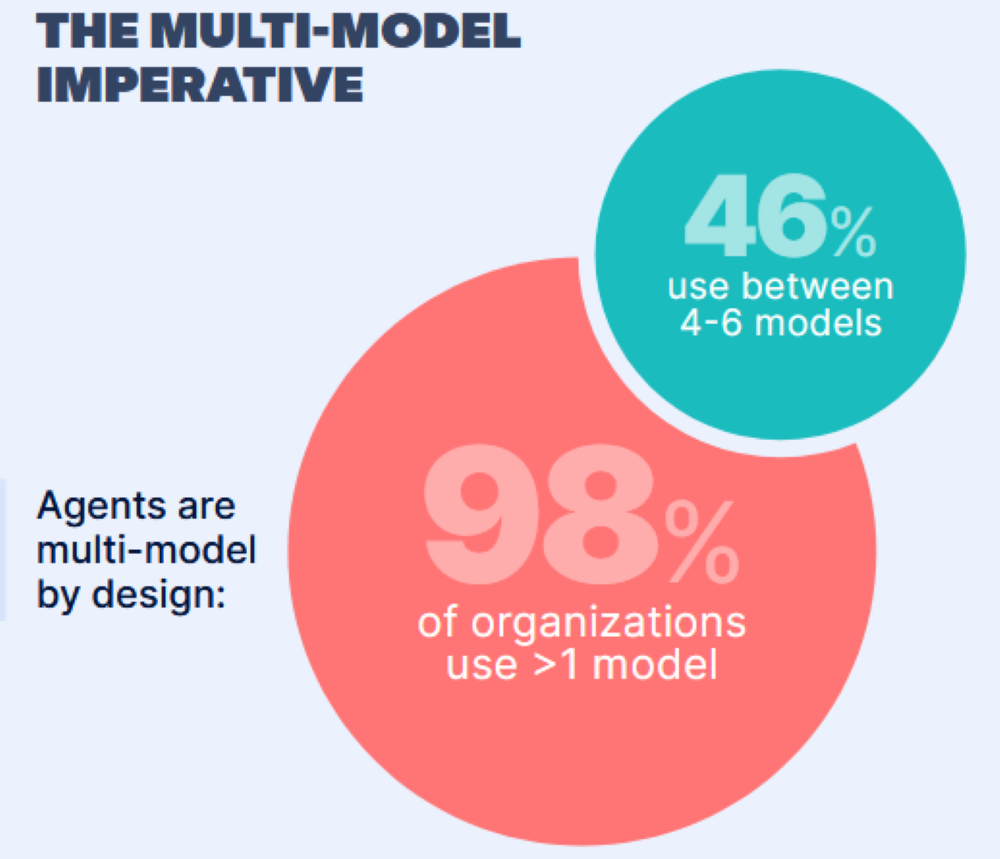
Our recent Agent AI study found that enterprises are embracing multi-model and multi-cloud architectures to gain greater control over performance, customization, privacy, and compliance. Multi-model is now the norm. Nearly two-thirds of organizations (61%) combine cloud-hosted and local models. And complexity doesn’t stop there: 46% report using between four and six models within their agents, while just 2% rely on a single model.
Deployment environments are just as diverse. 79% of respondents operate agents across two or more environments; 51% in public clouds, 40% on-premises, and 32% on serverless platforms.
This architectural flexibility delivers control, but it also multiplies orchestration and governance efforts. Coordinating models, tools, frameworks, and environments is consistently cited as one of the hardest parts of building agents. Nearly half of respondents (48%) identify operational complexity in managing multiple components as their biggest challenge, while 43% point to increased security exposure driven by orchestration sprawl.
The strategic shift away from vendor lock-in
As organizations double down on agent investments, concerns about supply chain fragility are rising. Seventy-six percent of global respondents report active worries about vendor lock-in.
Seventy-six percent of global respondents report active concerns about vendor lock-in
Rather than consolidating, teams are responding by diversifying. They’re distributing workloads across multiple models, tools, and cloud environments to reduce dependency and maintain leverage. Among the 61% of organizations using both cloud-hosted and locally hosted models, the primary drivers are control (64%), data privacy (60%), and compliance (54%). Cost ranks significantly lower at 41%, underscoring that flexibility and governance, not cost savings are shaping architectural decisions.
Containers power the next wave of agent adoption
Containerization is already foundational to agent development. Nearly all organizations surveyed (94%) use containers in their agent development or production workflows and the remainder plan to adopt them.
Nearly all organizations surveyed (94%) use containers in their agent development or production workflows and the remainder plan to adopt them.
As agent initiatives scale, teams are extending the same cloud-native practices that power their application pipelines such as microservices architectures, CI/CD, and container orchestration to support agent workloads. Containers are not an add-on; they are the operational backbone. In fact, 94% of teams building agents rely on them.
At the same time, early signs of orchestration standardization are emerging. Among teams building agents with Docker, 40% are using Docker Compose as their orchestration layer, a signal that familiar, container-based tooling is becoming a practical coordination layer for increasingly complex agent systems.
The agentic future won’t be monolithic
The agentic future won’t be monolithic. It’s already multi-cloud, multi-model, and multi-environment. That reality makes open standards and portable infrastructure foundational for sustaining enterprise trust and long-term flexibility.
What’s needed next isn’t reinvention, but standardization around an open, interoperable and portable infrastructure: the flexibility to work across any model, tool, and agent framework, secure-by-default runtimes, consistent orchestration and integrated policy controls. Teams that invest now in this container-based trust layer will move beyond isolated productivity gains to sustainable enterprise-wide outcomes while reducing vendor lock-in risk.
Download the full Agentic AI report for more insights and recommendations on how to scale agents for enterprise.
Join us on March 25, 2026, for a webinar where we’ll walk through the key findings and the strategies that can help you prioritize what comes next.
Learn more:
- Get your copy of the latest State of Agentic AI report!
- Learn more about Docker’s AI solutions
- Read more about why AI agents challenge existing governance approaches and explore a new framework designed for agentic AI.
from Docker https://ift.tt/x6UWI4d
via IFTTT


No comments:
Post a Comment