A development team scales its web application from one server to five to handle peak traffic. Within minutes, users report random logouts and lost shopping carts. The load balancer is routing requests across all instances, but session data exists only in the memory of the server that originally handled each user connection.
This is a common failure mode in distributed applications. Once requests start moving between instances, anything stored locally becomes a dependency. User sessions, shopping carts, workflow progress, cached application data – all of it needs to be available regardless of which server processes the next request.
The distinction between stateful and stateless design affects far more than session management. It shapes how applications scale, recover from failures, move between infrastructure nodes, and operate in Kubernetes environments. Where state lives and how it’s managed is a core architectural decision for any distributed service.
Here’s how each model works, where each fits, and what the operational tradeoffs actually look like in production.
What is a stateless application?
A stateless application doesn’t retain client-specific information between requests. Any running instance can process any request because the required context is either included in the request itself or pulled from external services. If an instance crashes and a replacement starts, no session data is lost because nothing was stored locally.
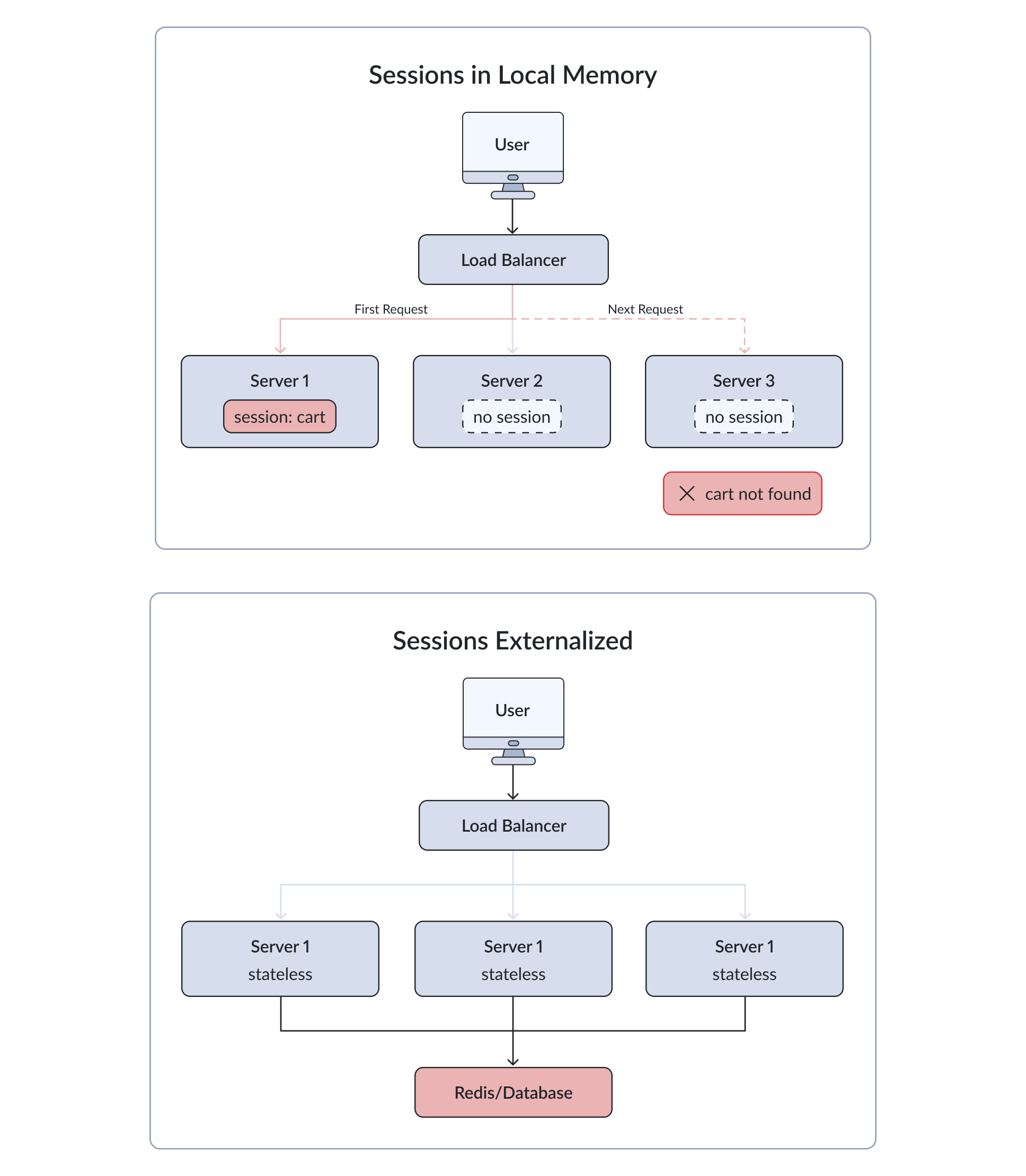
Common stateless workloads include REST APIs, static website delivery, frontend rendering containers, image and video processing workers that write results to object storage, and authentication services using self-contained JWTs (tokens that carry all the information needed to validate a request, so no server-side lookup is required). A web application that stores session data in Redis or a relational database rather than local memory is also effectively stateless at the application tier – any instance can serve any request.
Because requests are independent, adding or removing instances doesn’t require migrating user sessions or application data. You spin up another replica, point the load balancer at it, and it starts handling traffic.
One clarification. Stateless doesn’t mean data-less. A stateless API may query PostgreSQL, publish events to Kafka, and store uploaded files to S3. The application itself just doesn’t hold onto that information between requests.
What is a stateful application?
A stateful application retains information that affects future requests, transactions, or operations – persistent data, session context, replication metadata, application state on disk or in memory. Without that state, the application can’t continue operating correctly. Losing it often means losing data, transaction history, or consistency guarantees.
Databases are the obvious example. A PostgreSQL instance stores data files on disk and maintains active connection state. Starting a new instance without access to the original storage is effectively a different database. Message platforms like Kafka and RabbitMQ maintain queue state, consumer offsets, and replication metadata. Search platforms like Elasticsearch store indexes that must survive restarts and workload migrations.
Other examples include file servers, Redis deployments operating as primary data stores, multiplayer gaming platforms tracking live player sessions, and legacy enterprise applications that store session data locally.
Unlike a stateless container that can usually be replaced immediately, stateful services often need storage reattachment, integrity validation, and sometimes a recovery sequence before they can safely accept traffic.
Kubernetes formalizes this distinction through separate workload controllers. Deployments are designed for stateless workloads where pods are interchangeable. StatefulSets support applications that need persistent storage, stable network identities, and ordered startup and shutdown behavior.
How they differ
The simplest way to think about it: stateless applications treat each request independently, while stateful applications depend on information that must persist beyond the lifetime of a single request or process.
An API gateway validating a JWT can process requests on any available instance because it stores no client-specific information locally. A database, message broker, or gaming server can’t. Their operation depends on information accumulated over time and preserved across restarts, failures, and infrastructure changes.
That difference shows up in daily operations. Stateless services are easier to scale, replace, and recover because instances are interchangeable. Stateful workloads bring additional requirements around storage, replication, consistency, backup, and recovery.
| Factor | Stateless applications | Stateful applications |
| Request handling | Each request is self-contained | Requests may depend on previously stored state |
| Scaling | Horizontal scaling is straightforward | Scaling requires state replication, partitioning, or coordination |
| Load balancing | Any instance can serve any request | May require session affinity or access to shared state |
| Failure recovery | Failed instances can be replaced immediately | Recovery may require state restoration, validation, or synchronization |
| Storage | State is stored in external services | Persistent storage is integral to the workload |
| Kubernetes controller | Deployment | StatefulSet |
| Network identity | Instances are interchangeable | Stable network identity may be required |
| Examples | APIs, web frontends, processing workers | Databases, message queues, cache clusters, file servers |
The Twelve-Factor App methodology captures this same principle: keep application processes stateless and share-nothing wherever practical. Data that must survive application restarts belongs in backing services – databases, caches, object storage, messaging systems.
Real-world examples
Most production environments contain both models.
An e-commerce platform serves product information through stateless APIs while storing shopping cart data, inventory records, and order history in stateful backend systems. The API tier scales freely, but the underlying data must stay consistent.
Healthcare systems follow the same split. An appointment scheduling API that validates tokens and queries a calendar service can run statelessly across any number of replicas. The patient record database (Epic, Cerner, and similar EHR systems) is stateful: it needs transactional storage, consistent backups, and point-in-time recovery. A write that gets lost isn’t just a data problem – it’s a patient safety problem.
Payment infrastructure shows the same pattern. A payment API can be exposed through stateless service endpoints, while the transaction database behind it is stateful – recording every transaction, refund, and state change as permanent history.
Video streaming services often run metadata and recommendation APIs as stateless workloads behind load balancers. User watch history, playback position, subscription information, and billing records remain stateful and must survive infrastructure failures and regional failovers.
Kubernetes environments combine both approaches regularly. An NGINX frontend may run as a Deployment with multiple interchangeable replicas. PostgreSQL and Kafka typically run as StatefulSets because they depend on persistent volumes, stable identities, and controlled recovery procedures.
Scaling, recovery, and Kubernetes
Scaling stateless services? Add instances behind a load balancer. AWS Auto Scaling Groups, Kubernetes HPA, and Azure Container Apps all work on the same assumption: no instance owns session data, so new replicas start serving requests immediately.
Stateful services are harder to scale because the data layer becomes part of the decision. Adding a PostgreSQL read replica is routine. Expanding a Galera write cluster or rebalancing a Kafka deployment requires considerably more coordination – replication lag, quorum requirements, consistency guarantees, and storage performance all factor in.
Failure recovery follows the same pattern. Replacing a failed stateless container often means starting a replacement and redirecting traffic. Recovering a failed database node may involve storage validation, write-ahead log (WAL) replay, cluster reformation, and consistency checks before it can safely rejoin production.
In Kubernetes, Deployments manage stateless workloads. Pods are interchangeable: if one restarts on another node, Kubernetes launches the same image with the same configuration and resumes serving traffic. Rolling updates, rollbacks, and horizontal scaling work cleanly because pod identity doesn’t matter.
StatefulSets manage stateful workloads. Each pod gets a stable hostname (postgres-0, postgres-1) and typically its own PersistentVolumeClaim (a request for storage that Kubernetes binds to an actual volume). If postgres-0 is rescheduled to a different node, Kubernetes reattaches the original volume and preserves its data. Startup and shutdown follow an ordered sequence, which simplifies recovery and cluster coordination for databases, message brokers, and other distributed systems. (This ordered shutdown isn’t just convention – it protects quorum in clustered systems like etcd. That’s a deep dive for another time.)
PersistentVolumes and PersistentVolumeClaims provide the storage layer many StatefulSets depend on. Without persistent storage, a database pod recreated after a node failure may start with an empty data directory, resulting in data loss or cluster reinitialization.
ConfigMaps and Secrets hold configuration values, not transactional data. Teams that treat them as a substitute for application state usually discover the difference during an incident. I’ve seen this happen. It wasn’t pretty – the team spent two hours debugging what turned out to be a missing environment variable that had been stored in a ConfigMap they assumed was persisted, but the volume mount was misconfigured and the pod had been silently falling back to defaults for weeks.
Can a stateful application become stateless?
Many applications that appear stateful at the code level can be refactored to externalize their state. The compute layer behaves statelessly while all persistence moves to dedicated services.
The most common transformations:
- Move in-process session storage from application memory to a shared Redis cluster
- Replace sticky sessions with token-based authentication so any instance can validate any request
- Move uploaded files from container-local disk to object storage
- Write job progress to a database instead of holding it in process memory
AWS documents this pattern in its guidance on converting stateful architectures to stateless designs: moving session management to DynamoDB or ElastiCache, and user files to S3, removes the dependencies that make horizontal scaling complex and failover painful.
The compute tier gets the scaling and recovery properties of a stateless service. The stateful systems still exist – they’re just no longer inside the application process. Those data services now need dedicated storage planning, replication, backup schedules, and tested failover.
Storage and infrastructure requirements
Stateless compute services need reliable networking and a stable path to their backing services. Storage requirements are minimal: a container image, possibly a small ephemeral volume for temporary processing, and connection strings to external services.
Stateful services have a different set of requirements. They need persistent storage that survives pod restarts and node failures. Performance matched to the workload (NVMe or low-latency flash for transactional databases, high-capacity storage for archives and cold data). Replication so a single drive or node failure doesn’t cause data loss. Snapshots and backups for point-in-time recovery. HA clustering so a node failure doesn’t take the service offline.
For virtualized databases, file services, and application clusters, shared storage is often the foundation of availability. Software-defined storage handles this by mirroring local drives between cluster nodes and presenting a shared fault-tolerant volume to the hypervisor, removing the external SAN from the HA path. VMware vSAN takes this approach on vSphere clusters. StarWind Virtual SAN covers the same pattern for both Hyper-V and VMware environments and is common in two-node configurations where adding a physical witness server would increase hardware cost without proportional benefit.
Disaster recovery also differs between the two models. Restoring a stateless service is often as simple as redeploying its configuration and application image. Restoring a stateful service requires verified backups, tested recovery procedures, and in many cases replicated data at a secondary location to meet recovery objectives.
How to choose between stateful and stateless
A few questions usually determine the answer:
- Can any instance process any request without prior context?
- Does the application need to retain session information between requests?
- What happens if an instance restarts?
- Where is persistent data stored?
- Does the workload require a stable identity?
- Does startup order matter?
These questions are useful, but they’re abstract. Walking through a concrete example makes the decision clearer.
Consider a notification delivery service. It reads messages from a queue and sends emails, SMS, or push notifications to users. On the surface, it’s stateless: any instance can pick up any message and deliver it.
But what about retries? If delivery fails, the service needs to know it failed, schedule a retry, and track how many attempts have been made. That’s state. What about rate limiting? If you’re sending to a carrier that throttles at 100 messages per second per sender, the service needs to track the current send rate. More state. What about delivery receipts? If downstream providers send webhook confirmations that a message was delivered, those receipts need to be matched to the original message. State again.
You can solve each of these two ways. Keep the retry counters, rate limits, and delivery receipts in the application process (stateful) or externalize them to Redis, a database, or a message queue with visibility timeouts (stateless compute backed by stateful services). The first approach is simpler to build. The second is simpler to operate at scale, because you can add more compute instances without worrying about which instance owns which piece of state.
In most architectures, the preferred approach is to keep the application tier stateless and move persistence into dedicated services designed for storage, replication, backup, and recovery.
Common mistakes
Storing sessions only in local process memory is the most common early mistake. When the process restarts or a load balancer routes to a different instance, the session is gone. Store session state in a shared service like Redis, Memcached, or a database that all application instances can reach.
Writing uploaded files to container-local disk causes a similar class of failure. Container restarts and pod rescheduling destroy ephemeral storage. User-generated content needs to go to object storage on the first request, not after the first incident.
Running databases in Kubernetes without persistent volumes is specific to container environments but remains common. If persistent storage is missing or incorrectly configured, a recreated database pod may start with an empty data directory or fail to recover correctly. Test pod failure and PVC reattachment before you go to production. Don’t skip it.
Sticky sessions are a short-term workaround that teams often mistake for a scaling strategy. They work until the instance holding those sessions fails, at which point every affected user loses their state simultaneously. Externalizing session state removes that dependency.
Skipping backup and restore testing for stateful services creates a false sense of security. Backups that haven’t been tested as restores are an unknown quantity. The gap shows up during an actual incident, when you discover the backup was corrupted three weeks ago and nobody noticed.
Treating cache as the source of truth is a design error with a predictable failure mode. In-memory caches like Redis are fast but volatile in default configurations. Any data that can’t be lost needs a durable store behind it, with the cache serving as acceleration, not storage.
Confusing stateless applications with stateless systems is another common mistake. A stateless API may still depend on databases, message brokers, caches, and object storage that hold critical application state. Making the application tier stateless simplifies operations, but the underlying state still needs protection, replication, backup, and recovery planning.
Conclusion
Stateless application tiers scale and recover easily because no instance owns data – replace a pod, and nothing is lost. Stateful services are unavoidable wherever data, sessions, ordering, or persistence matter, and they require dedicated storage, replication, backup, and tested failover.
Most production systems combine both. Stateless tiers handle user requests and business logic. Stateful services manage databases, message queues, caches, and persistent storage. If you’re designing a new service, default to stateless compute with externalized state and invest your operational complexity budget in the data layer where it belongs.
FAQ
What is the difference between stateful and stateless applications?
A stateless application processes each request independently and does not retain client-specific state between requests. A stateful application depends on stored data, session context, or persistent identity to function correctly across requests or restarts.
Is REST stateless?
The REST architectural style defines statelessness as a constraint: each request must carry all the information needed to process it, and the server stores no session state between requests. Many APIs described as REST do use server-side sessions, which technically violates this constraint.
Is a database stateful or stateless?
Databases are stateful. They accumulate and persist data, maintain transaction and connection state, and require persistent storage to function. This is the fundamental reason databases need different operational treatment than application containers.
What is the difference between Deployment and StatefulSet?
A Deployment manages interchangeable pods that can be replaced and rescheduled freely. A StatefulSet assigns each pod a stable identity and its own persistent storage, and enforces ordered startup and shutdown sequences.
Can a stateful app be converted to stateless?
The application tier of many stateful applications can be made stateless by moving session data, file storage, and persistence to external services. The overall system remains stateful because the data still exists; it is simply managed outside the application process.
Is Redis stateful or stateless?
Redis is generally considered stateful because it stores data that applications depend on. When used for caching, data loss may be acceptable. When used for sessions, queues, or as a primary data store, Redis becomes a critical stateful component that requires persistence, replication, and backup planning.
Which is better: stateful or stateless?
Neither is universally better. Stateless application tiers are easier to scale, replace, and operate. Stateful data services are unavoidable for any application that needs to retain information. The best architectures use stateless compute and treat their stateful data services as the critical infrastructure they are.
from StarWind Blog https://ift.tt/F4OYBcb
via IFTTT


No comments:
Post a Comment