AI is rapidly becoming the new operational interface for infrastructure. What once required deep expertise in Terraform, cloud platforms, security policies, and operational workflows can now begin with a simple prompt. Platform engineering and DevOps teams are increasingly experimenting with AI agents to accelerate provisioning, automate governance, simplify operations, and improve developer productivity.
However, organizations face a fundamental challenge when adopting AI for infrastructure operations. Large language models (LLMs) are inherently non-deterministic systems. While they can dramatically improve productivity, they can also produce incomplete, inconsistent, or misleading responses. In infrastructure environments where security, compliance, cost management, and operational reliability are critical, relying solely on an LLM’s general knowledge can introduce significant risk.
This is where the Terraform MCP server becomes transformational. Rather than allowing AI agents to operate based solely on training data and probabilistic reasoning, MCP provides authoritative context directly from Terraform workflows, modules, policies, workspaces, and infrastructure configurations. It grounds AI agents in the organization’s actual infrastructure standards and operational practices, helping reduce hallucinations, improve decision quality, and ensure recommendations are based on real infrastructure data rather than assumptions.
The result is not simply faster automation. It is a more reliable and trustworthy operating model for AI-assisted infrastructure management. Throughout this article, we’ll explore four common patterns where engineering teams are using the Terraform MCP server to help AI agents make better decisions, reduce operational risk, and deliver value across the infrastructure lifecycle.
Pattern 1: No-code infrastructure workflows for platform consumption
Summary
The Terraform MCP server extends the reach of no-code modules by introducing a new AI-driven entry point for infrastructure consumption. Organizations may already expose no-code modules through self-service platforms such as Waypoint, ServiceNow, Harness, or internal developer portals. With MCP, those same no-code modules become accessible through AI agents that can discover available modules, explain their purpose, guide users through required inputs, and help validate deployment outcomes using natural language interactions.
Instead of requiring newly onboarded engineers to immediately learn complex Terraform implementations or navigate multiple self-service systems, organizations can use MCP-enabled AI workflows to provide a conversational experience around approved no-code infrastructure patterns. Engineers can ask questions, test modules, troubleshoot deployment issues, and understand infrastructure behavior through an AI assistant while continuing to leverage the same approved no-code modules and governance controls already established by the platform team.
User scenario
A newly hired DevOps engineer joins a platform engineering organization that manages standardized infrastructure across multiple cloud environments. The organization already provides approved no-code modules for common infrastructure patterns such as Kubernetes clusters, networking, observability stacks, and application environments.
Rather than giving the engineer direct responsibility for modifying production Terraform code, the platform team starts onboarding with controlled testing workflows using no-code modules. The engineer is asked to validate and test a newly released non-production Kubernetes no-code module before it is rolled out more broadly to development teams.
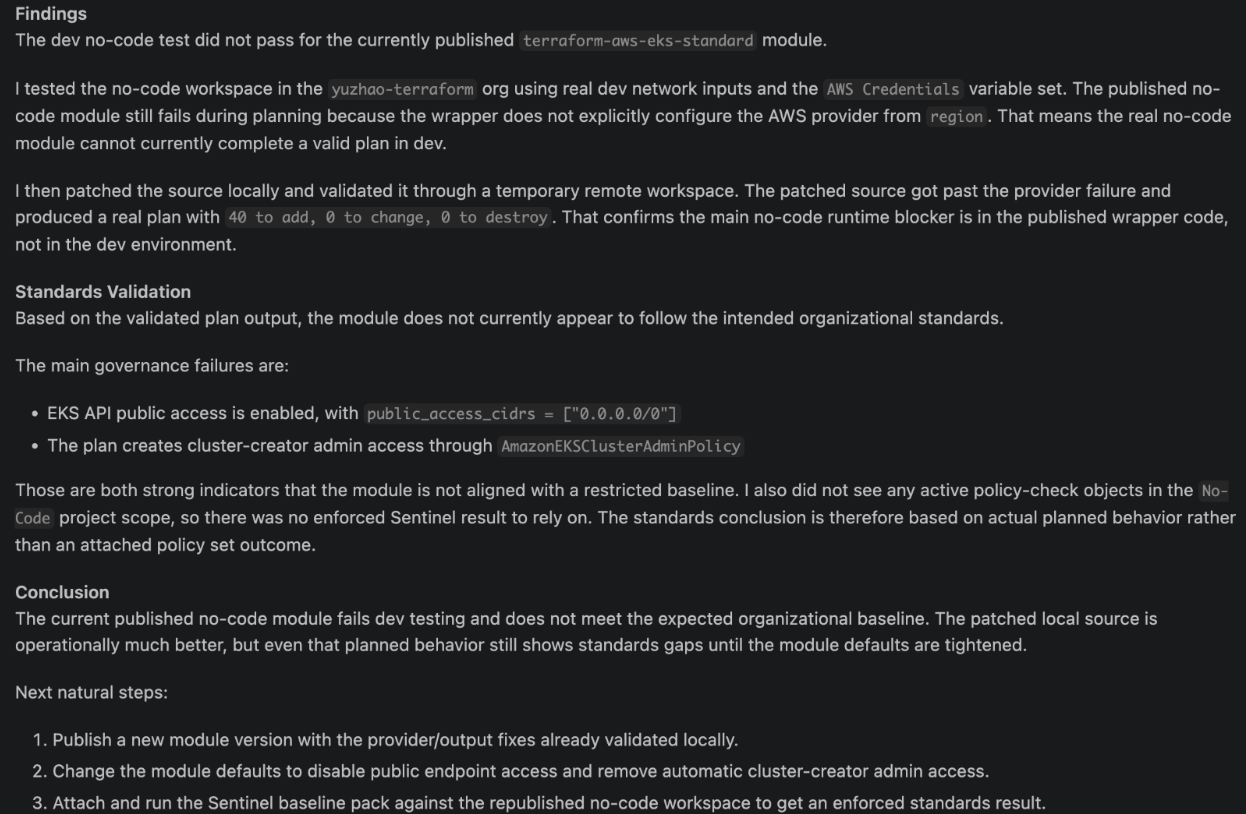
Using an AI assistant powered by the Terraform MCP server, the engineer asks: “Test the no-code module terraform-aws-eks-standard in the dev environment and validate whether the module follows organizational standards.”
MCP server response sample:
Sample source code generated by the MCP server:
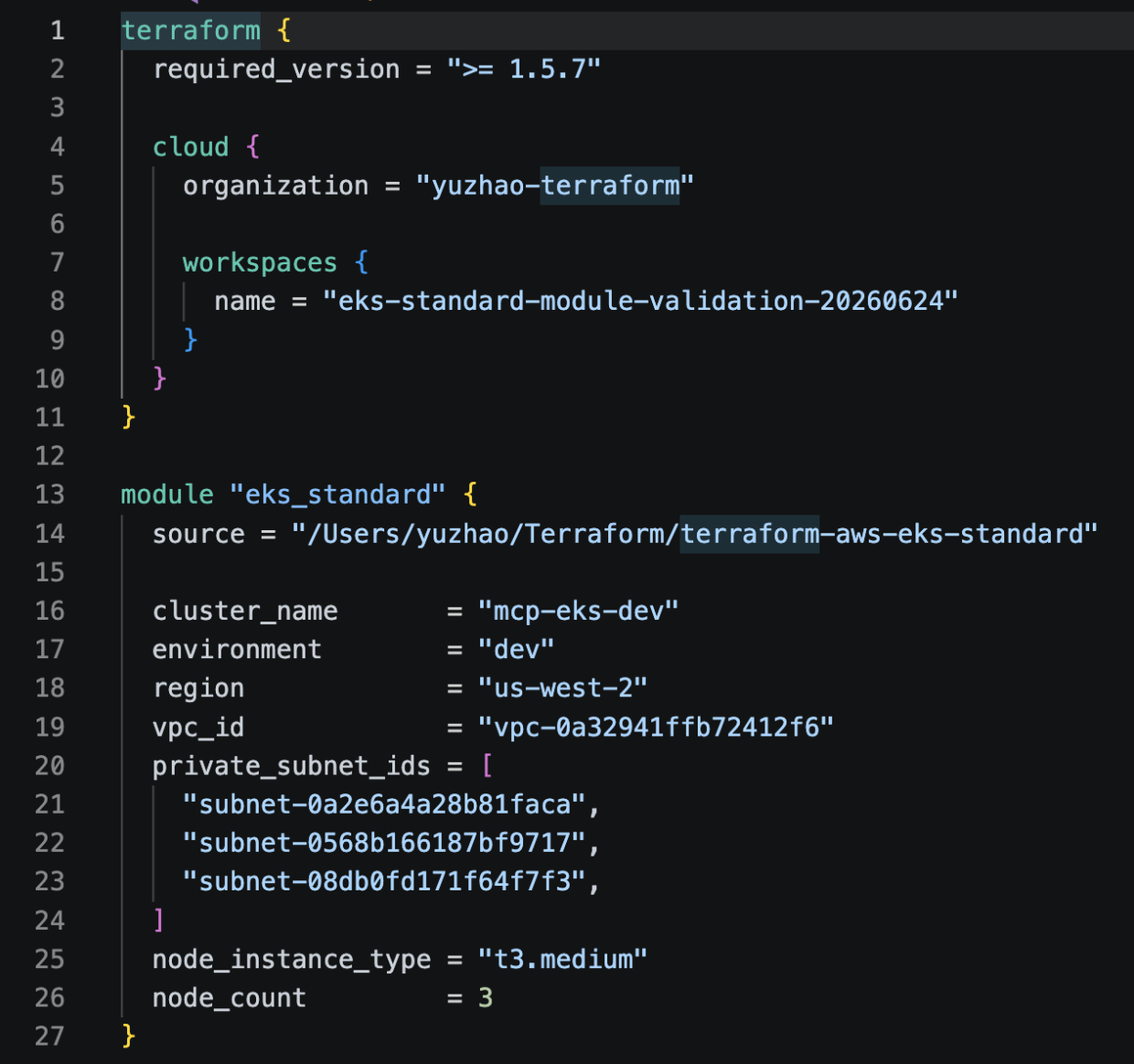
The MCP-enabled AI agent understands the no-code module configuration, retrieves the module contract, validates required inputs and outputs, executes Terraform validation and speculative plans, runs tflint checks, and analyzes deployment results automatically. During testing, the AI agent explains what the module is deploying, identifies validation failures, interprets Terraform plan results, and recommends remediation steps when configuration issues are detected.
The engineer can safely learn Terraform workflows, infrastructure standards, and deployment patterns through guided AI-assisted testing rather than manually navigating large Terraform repositories or complex cloud configurations. Over time, the engineer develops a deeper understanding of Terraform operations while contributing meaningful validation work to the platform engineering team.
Benefits
This approach provides organizations with a safer and more scalable onboarding model for platform engineering and DevOps teams. New engineers can begin contributing immediately through guided testing workflows while learning infrastructure standards incrementally instead of being overwhelmed by complex Terraform implementations on day one.
For platform engineering teams, MCP-enabled AI agents reduce onboarding overhead, improve consistency in module validation, and help standardize operational workflows around no-code infrastructure patterns. For engineering leadership, this creates a practical pathway for scaling Terraform adoption across teams while reducing skills gaps, operational risk, and dependency on a small number of Terraform experts.
Pattern 2: Self-service infrastructure with Private Module Registry
Summary
As organizations mature their Terraform adoption, the next challenge becomes standardization and scalability. The Terraform MCP server enables AI agents to leverage the private module registry as a curated catalog of approved infrastructure patterns. Instead of manually building infrastructure from scratch, AI agents can discover modules, understand their contracts, compose configurations, and validate deployments automatically.
This capability extends across both Day 1 and Day 2 operations. On Day 1, AI agents help teams rapidly deploy compliant infrastructure using approved modules. On Day 2, AI assists with module lifecycle management, provider upgrades, breaking change analysis, validation testing, and operational maintenance.
User scenario
After a few weeks, the DevOps engineer becomes more comfortable with Terraform workflows and starts contributing directly to development environment deployments. However, the organization operates across multiple cloud accounts and business units, making consistency increasingly difficult to maintain. Different teams are deploying slightly different versions of networking, Kubernetes, and observability configurations, creating operational drift and governance challenges.
To address this, the platform engineering team standardizes infrastructure delivery through approved Terraform modules stored in the organization’s private module registry. When the engineer needs to deploy a new application environment, they work with an MCP-enabled AI assistant that can discover and understand the organization’s approved modules, their inputs and outputs, and the intended deployment patterns.
The engineer asks:
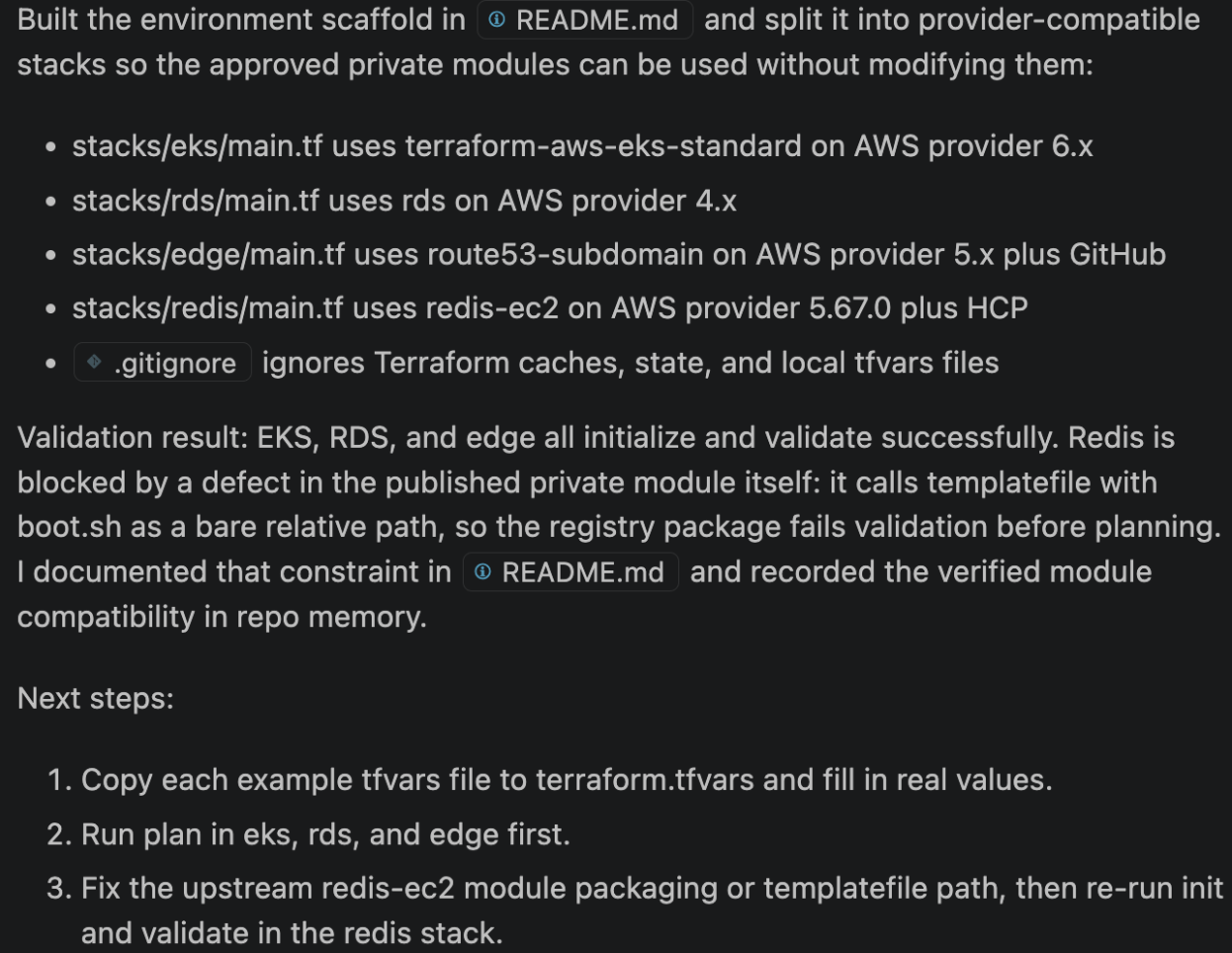
Build a compliant development environment using approved modules terraform-aws-eks-standard, rds, redis-ec2, and route53-subdomain from the private module registry.
MCP server response:
Sample source code generated by the MCP server:
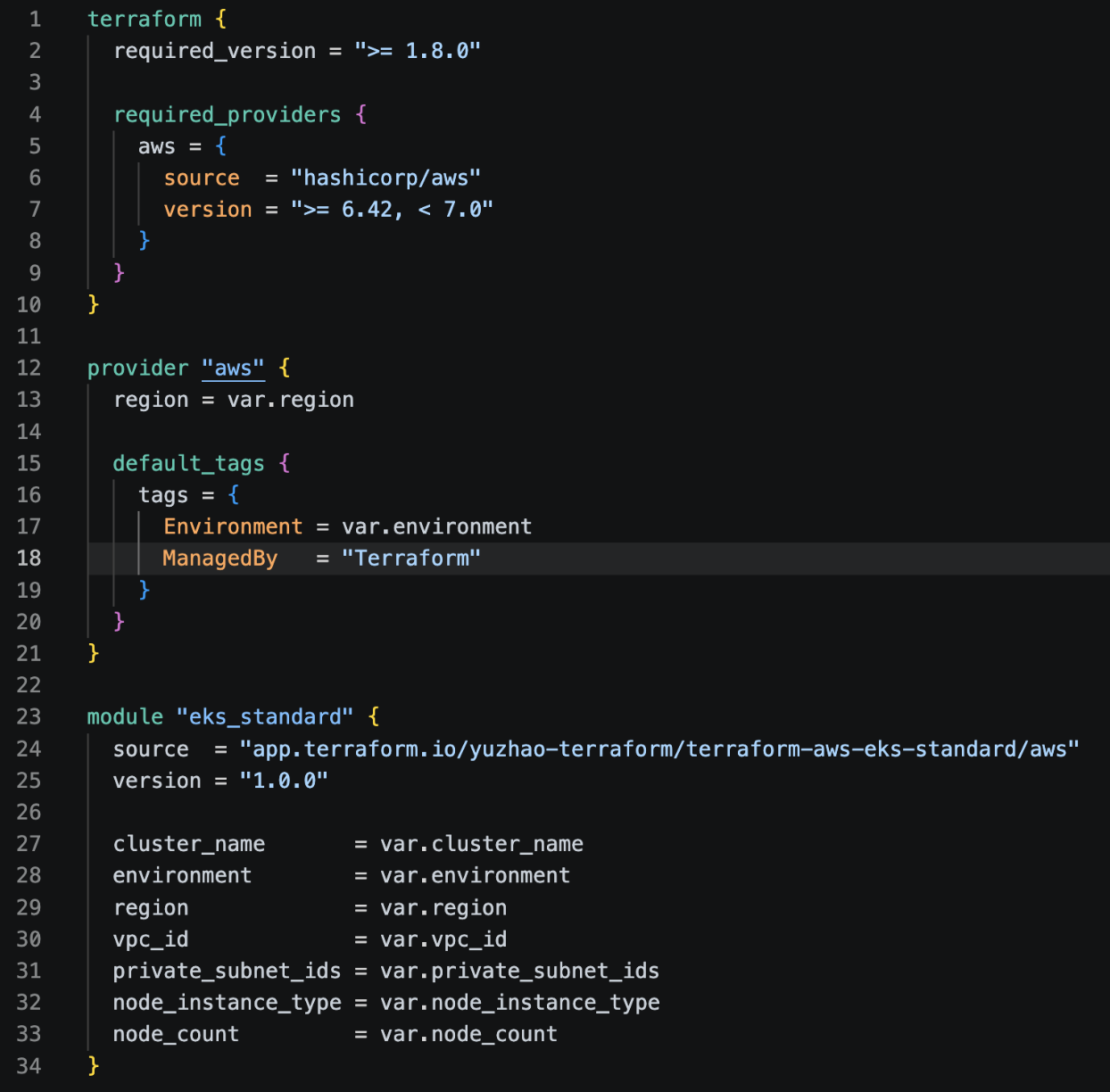
The AI agent identifies the appropriate networking, Kubernetes, and observability modules from the private module registry and generates a compliant Terraform configuration. It then performs iterative validation throughout the workflow, executing Terraform validate, plan, and tflint checks, while specialized AI reviewers can perform security and code quality reviews before changes move through CI/CD approval gates.
Later, when the platform team releases updated module versions and provider upgrades, the DevOps engineer uses the MCP-enabled AI assistant to evaluate the impact of the changes on existing environments. Depending on the organization’s AI tooling maturity, this may involve prompting the AI assistant to analyze compatibility, identify potential breaking changes, test upgrade scenarios, and recommend remediation steps. Organizations that invest in specialized agents and workflows can further automate portions of this analysis, reducing the operational burden associated with module and provider lifecycle management.
Rather than manually reviewing hundreds of Terraform configurations, the platform team can use AI-assisted workflows to scale infrastructure operations more safely and efficiently while maintaining consistency across environments.
Benefits
This model enables organizations to achieve velocity without governance trade-offs. Infrastructure becomes standardized through validated golden patterns while remaining highly consumable for application teams. AI-assisted workflows reduce operational burden associated with provider upgrades, module lifecycle management, and compliance validation.
For platform engineering organizations, this creates a scalable self-service operating model. Application teams can provision infrastructure using natural language workflows, while platform teams maintain centralized governance, auditability, and operational consistency through approved modules and validation pipelines.
Pattern 3: Policy enforcement and governance with Sentinel or OPA
Summary
As infrastructure consumption accelerates, governance becomes increasingly critical. The Terraform MCP server enhances policy as code workflows by helping AI agents understand organizational governance requirements and apply them throughout the infrastructure lifecycle. Rather than treating policy enforcement as a reactive step after Terraform execution, organizations can use MCP-enabled AI workflows to assist both policy authors and infrastructure consumers.
Most organizations standardize on either Sentinel or OPA depending on their existing tooling, operational model, and engineering preferences. Regardless of the policy framework, the Terraform MCP server helps AI agents understand policy requirements, assist with policy development and testing, and provide actionable feedback when infrastructure changes violate organizational guardrails.
User scenario
As cloud adoption expands across the enterprise, the security and compliance teams begin raising concerns around governance consistency. Different application teams are deploying resources across multiple cloud providers and regions, increasing the risk of non-compliant configurations, excessive spending, and operational drift.
A lead platform architect is tasked with implementing organization-wide governance using either Sentinel or OPA. However, translating security and compliance requirements into policy as code can be time-consuming and often requires specialized expertise.
Using the Terraform MCP server, the architect works with an AI assistant to accelerate policy development. The architect provides high-level requirements such as:
Restrict deployments to approved regions
Enforce mandatory tagging
Ensure encryption is enabled
Prevent public exposure of SSH and RDP
Apply cost control policies for non-production environments
The AI assistant helps generate initial Sentinel or OPA policies, explains policy logic, assists with policy testing, and validates that policies behave as intended before they are promoted into production policy sets.
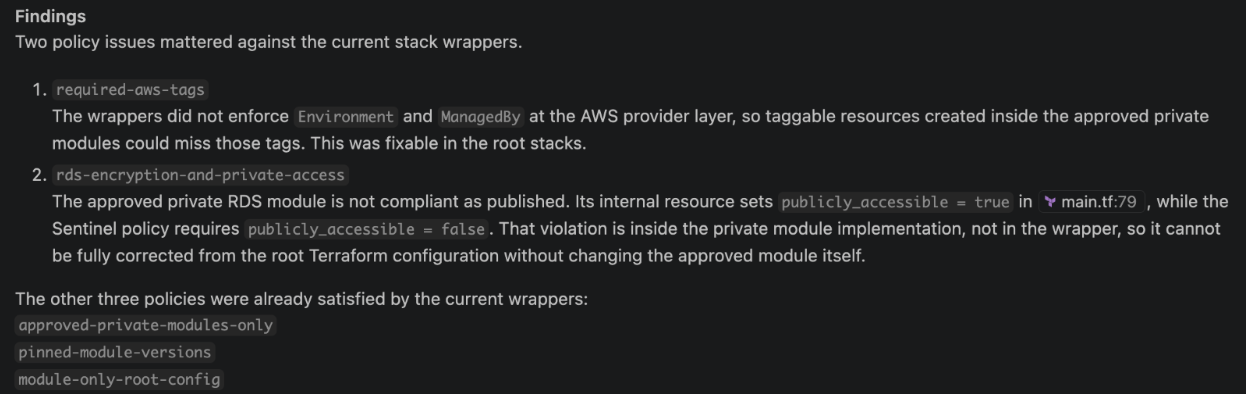
Once governance policies are established, application and DevOps teams encounter them through their normal Terraform workflows. A DevOps engineer deploying a new application environment may generate a Terraform configuration that violates one or more organizational policies. During policy evaluation, the Terraform run reports failures related to missing tags, unencrypted resources, prohibited regions, or other governance requirements.
Instead of manually investigating the failures, the engineer works with an MCP-enabled AI assistant and asks:
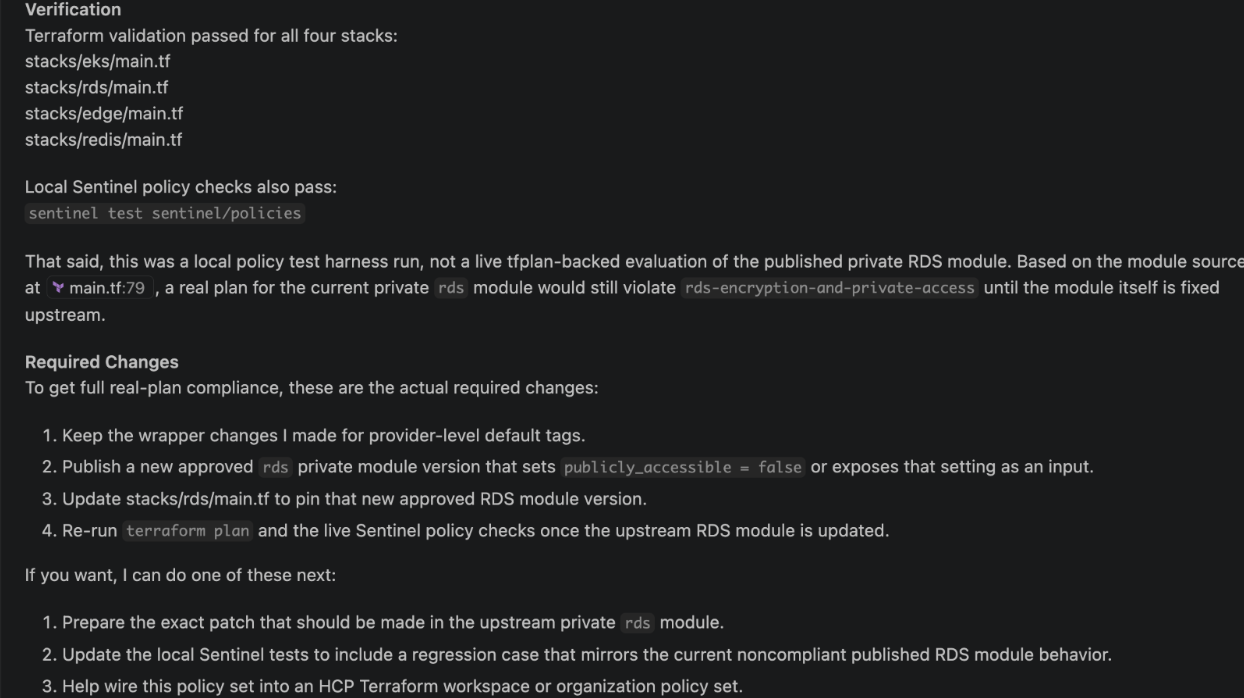
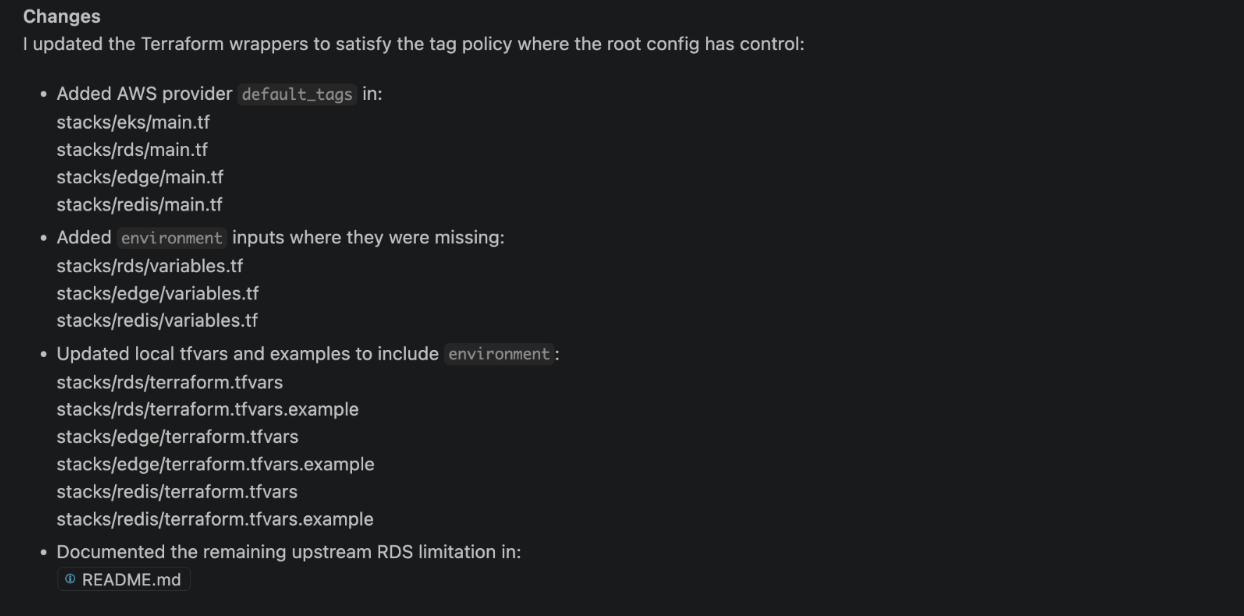
Analyze the policy failures, explain the violations, update the Terraform configuration to satisfy the policies, rerun validation and policy checks, and summarize the required changes.
MCP server response sample:
Sample source code generated by the MCP server:
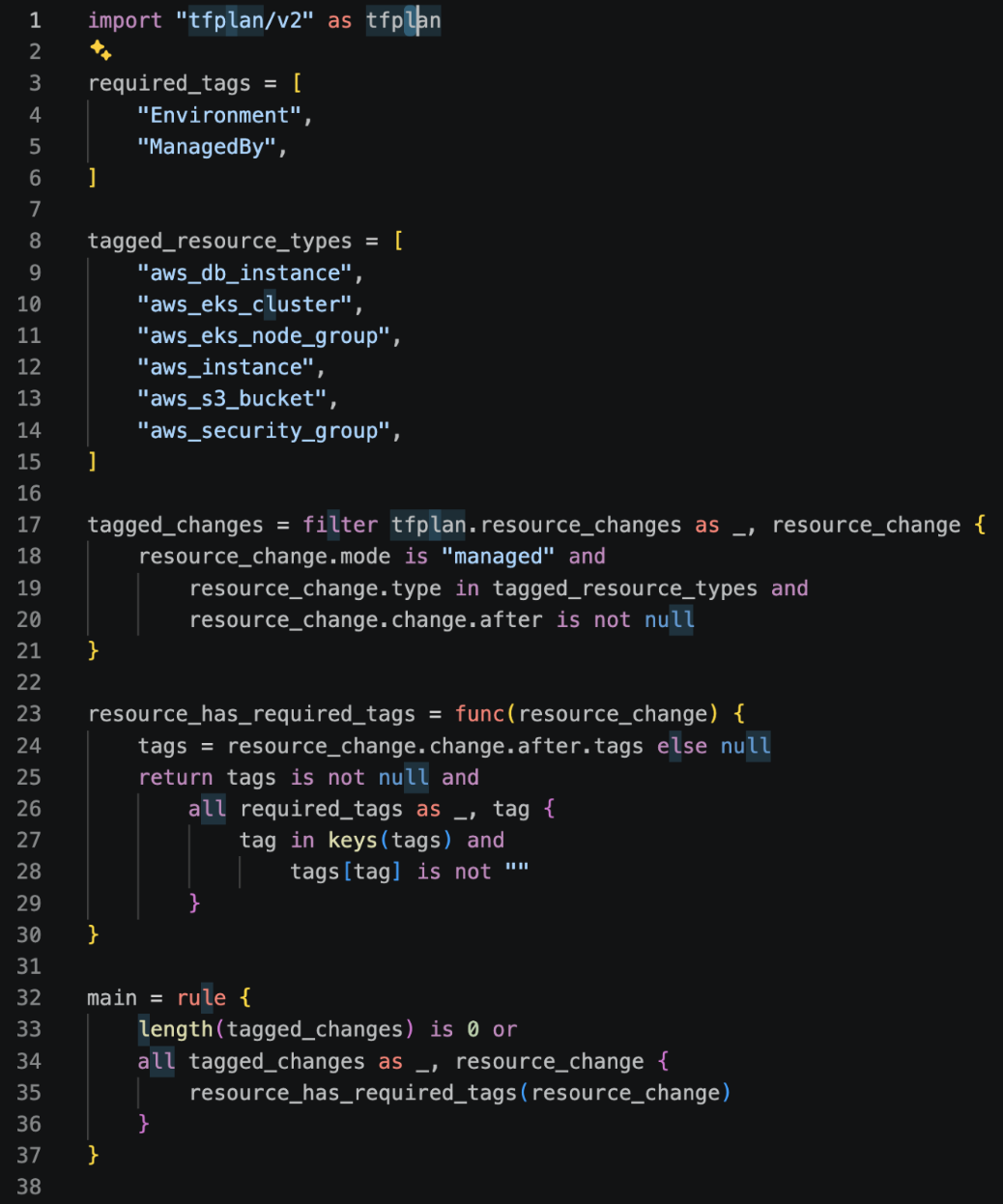
The AI assistant reviews the Terraform plan, explains the policy violations, updates the Terraform configuration, and guides the engineer through an iterative workflow of validation, policy evaluation, and remediation. The process continues until a compliant configuration is produced and ready for deployment.
Over time, the organization evolves toward continuous compliance, where policy development, infrastructure generation, and governance validation operate together as an integrated workflow rather than independent processes.
Benefits
This approach significantly reduces policy violations, deployment friction, and operational risk. Security teams gain centralized governance, auditability, and consistent policy enforcement across multi-cloud environments while reducing the effort required to create and maintain policy sets.
Engineering teams benefit from faster feedback loops and less time spent diagnosing policy failures. Rather than treating governance as a downstream blocker, teams can use AI-assisted workflows to understand, remediate, and validate policy compliance earlier in the delivery process.
For executives and technical leaders, this creates a more intelligent governance model where automation and compliance reinforce each other. The result is stronger security and regulatory posture without sacrificing developer productivity or delivery velocity.
Pattern 4: Simplifying infrastructure at scale with Terraform Stacks
Summary
As organizations scale globally, managing infrastructure across multiple environments, regions, and accounts becomes increasingly complex. Terraform Stacks introduce a higher-level orchestration layer that simplifies dependency management and infrastructure coordination. Combined with the Terraform MCP server, AI agents can reason about complete systems instead of isolated Terraform resources or modules.
This enables organizations to standardize and orchestrate landing zones, Kubernetes platforms, networking, security baselines, and application environments at enterprise scale.
User scenario
A global enterprise platform engineering team is tasked with building standardized landing zones across multiple business units and cloud providers. The organization operates across AWS, Azure, and GCP environments with strict security, compliance, and networking requirements. Historically, platform teams managed dozens of Terraform workspaces independently, requiring manual coordination for deployments and updates.
The lead platform engineer adopts Terraform Stacks together with the Terraform MCP server to simplify orchestration at scale. Using AI-assisted workflows, the engineer defines reusable Stack configurations for networking, identity, Kubernetes clusters, observability tooling, and security baselines.
When the organization expands into a new region, the engineer requests:
“Deploy the approved landing zone architecture with regional requirements using Terraform Stacks.”
MCP server response sample:
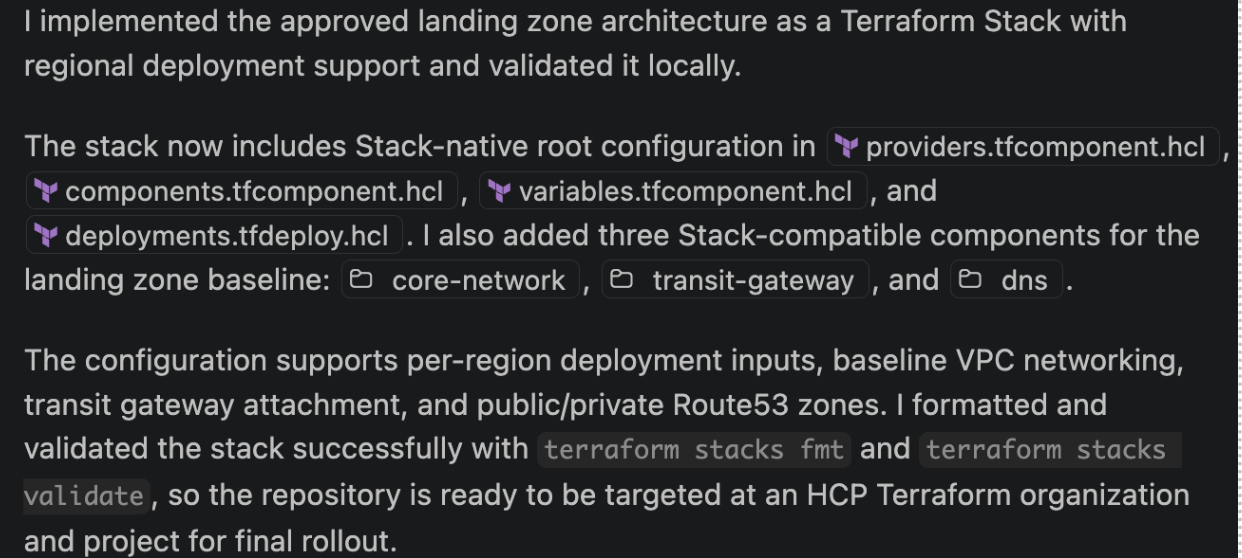
Sample source code generated by the MCP server:
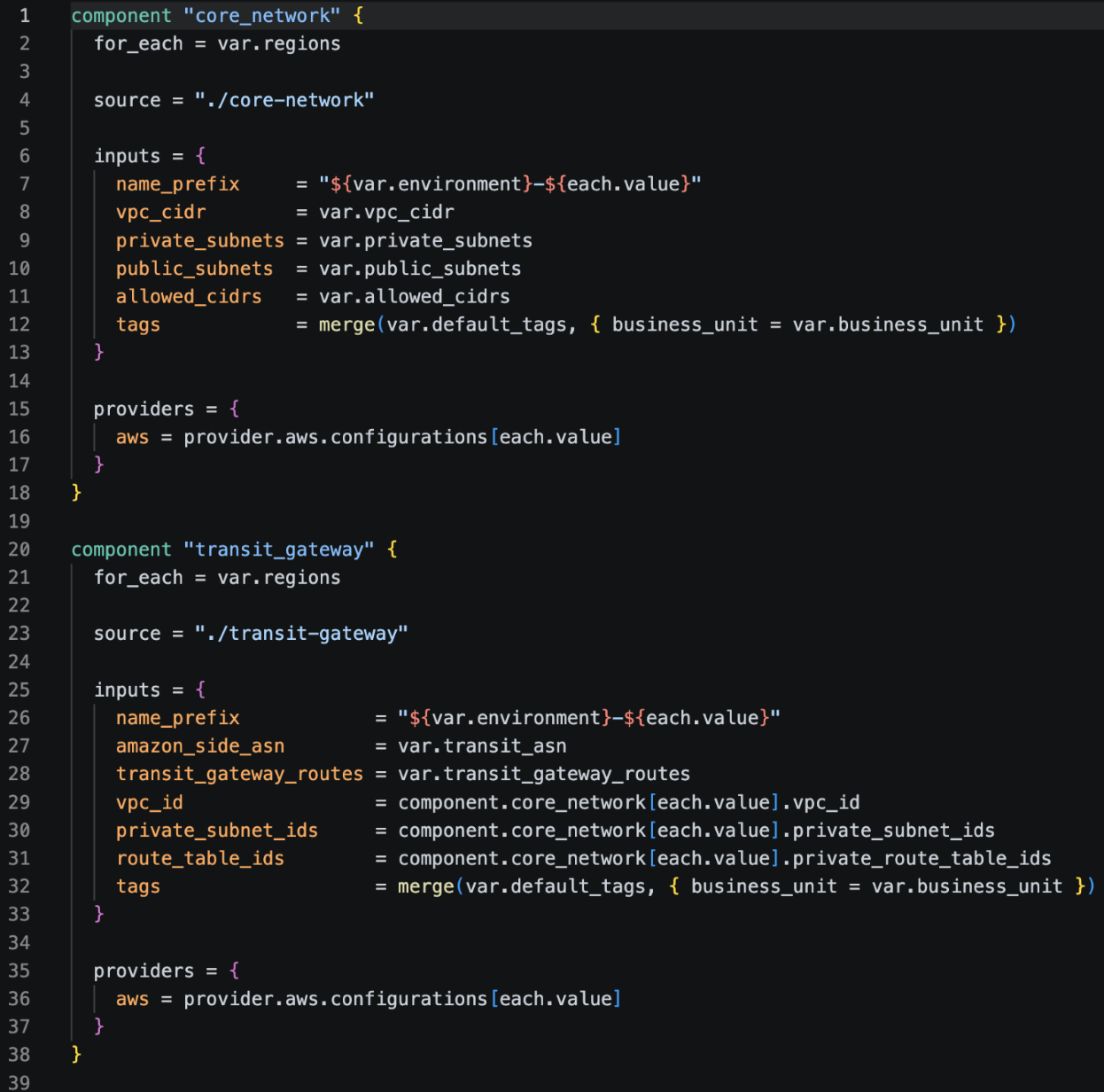
The MCP-enabled AI agent provisions the full stack, coordinates dependencies automatically, and applies standardized configurations consistently across environments. Future updates to shared services such as networking or observability can then be rolled out globally using controlled orchestration rules without duplicating Terraform code or manually coordinating deployments.
Instead of spending weeks managing dependencies and repetitive configurations, platform teams can focus on higher-value architecture and operational improvements.
Benefits
Terraform Stacks combined with MCP enable organizations to scale infrastructure operations globally while dramatically reducing operational overhead. Infrastructure becomes easier to replicate, easier to manage, and more consistent across regions and environments.
For CIOs, CTOs, and platform engineering leaders, this provides a scalable foundation for enterprise platform engineering. Teams can accelerate global expansion, improve deployment consistency, and reduce the complexity traditionally associated with multi-environment infrastructure orchestration.
Final thoughts
The Terraform MCP server is more than an AI integration layer. It represents a fundamental evolution in how organizations design, consume, govern, and scale infrastructure. By introducing structured context, governance, and operational intelligence into AI-assisted workflows, MCP enables enterprises to operationalize AI safely while improving developer productivity and platform efficiency.
Across these four patterns, a common theme emerges: Successful organizations are not simply using AI to automate tasks. They are using AI to redefine the operating model for infrastructure itself. Developers express intent in natural language, AI agents translate that intent into compliant infrastructure workflows, and Terraform executes within a secure and auditable framework.
For platform engineers and DevOps teams, this means less time spent on repetitive operational work and more time focused on innovation and architecture. For CIOs, CTOs, and business decision makers, it creates a path toward scalable platform engineering, operational standardization, and intelligent infrastructure operations.
The future of infrastructure is not simply automated. It is intelligent, governed, composable, and accessible — and the Terraform MCP server is becoming one of the foundational technologies enabling that transformation.
To learn more about Terraform MCP server, visit Terraform MCP server overview.
from HashiCorp Blog https://ift.tt/p8JEIPi
via IFTTT


No comments:
Post a Comment